How Often Do Americans Grocery Shop — And How Does That Compare to the Rest of the World?
Ask most Americans how often they grocery shop and you'll hear some version of "once a week, usually Sunday." It's so ingrained it barely feels like a choice — it's just what you do. Load up the cart, stock the fridge, and try to make it last seven days.
But spend a few days in Tokyo, Shanghai, or Paris, and you'll notice something different. People are buying groceries constantly — a few things at a time, sometimes every single day. And they're not doing it out of inconvenience or forgetfulness. It's a fundamentally different philosophy about what food is, how fresh it should be, and what the act of shopping is actually for.
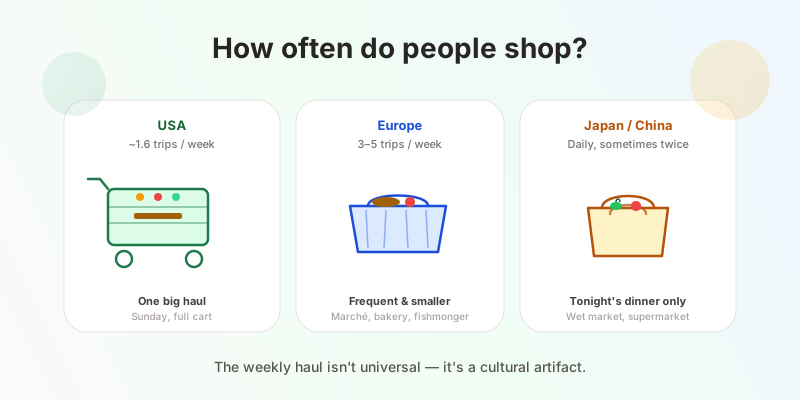
Shopping Frequency
How often households shop, by country
Approximate weekly trip averages. The U.S. figure is from Statista/Provoke Insights consumer surveys (2023–2024). Other values are reasonable midpoints from European, Japanese, and Chinese consumer research and qualitative reporting — exact numbers vary by city, age, and household type.
The American Approach: The Weekly Haul
The average American makes about 1.6 grocery trips per week. A 2023 survey found that 41% of U.S. shoppers do one major grocery run per week, while 29% go two to three times. Only about 6% shop daily.
By 2024, that number had actually contracted further — the average American was making roughly six grocery trips per month, down from eight in 2022. Higher food prices pushed households to consolidate trips, plan meals more carefully, and stretch their pantry further between runs.
The American weekly shop is a product of its infrastructure. It was built for it:
The car made distance irrelevant. When you can drive, the grocery store doesn't need to be around the corner. American suburbs were designed around car access, which meant grocery stores could be large, infrequent, and far — the superstore model rather than the corner shop model.
The refrigerator made storage easy. Large American refrigerators (and chest freezers in the garage) made it practical to buy a week's worth of produce, meat, and dairy at once. European apartments often have significantly smaller refrigerators — in part because daily shopping makes a large fridge unnecessary.
Big-box retail made bulk buying cheap. Costco, Sam's Club, and the warehouse model rewarded buying more less often. The American grocery psyche gravitates toward unit economics: the more you buy at once, the lower the per-unit cost.
Why It Looks This Way
Three pillars of the American weekly shop
The car
Suburbs were designed around it. The store can be far, large, and infrequent.
The big fridge
A week of produce, meat, and dairy fits at home. There is no need to buy fresh tomorrow.
Big-box pricing
Costco, Sam’s Club, and warehouse stores reward buying more, less often. Unit economics win.
The weekly haul isn\u2019t a habit so much as a system. Change any one of these inputs and the optimal shopping pattern starts to drift toward something else.
The result is a very efficient, very planned approach to food. It also means that by Thursday or Friday, a lot of American households are eating from the back of the fridge — and a lot of produce that was bought on Sunday has started to turn.
The Tradeoff
What freshness looks like across the week
Illustrative — actual decay varies by item. Hardy produce (carrots, cabbage) holds longer; herbs, berries, and leafy greens drop faster. The point is the shape, not the precise percentages.
Europe: The Frequent, Smaller Shop
Europeans shop more often and buy less each time. According to consumer research, 67% of European shoppers visit a physical store once or several times a week, and 12% shop daily — roughly double the U.S. daily shopping rate.
In France, the cultural attachment to fresh food borders on philosophical. The daily baguette run is real — many French households buy bread every day because day-old bread is considered genuinely inferior. The same logic extends to produce, fish, and dairy. Many French cities have weekly or twice-weekly outdoor markets (marchés) where locals do a significant portion of their fresh food shopping. The French supermarché exists, but it competes with a dense ecosystem of specialty shops — the butcher, the fishmonger, the fromagerie — that have no American equivalent outside of a handful of major cities.
In Italy, the mercato rionale (neighborhood market) plays a similar role. Markets typically open early in the morning and sell out of the best produce by midday. Shopping there isn't just transactional — it's part of the neighborhood's social fabric. The vendor knows what you usually buy. You ask what arrived fresh that morning and plan dinner around the answer.
What makes European frequent shopping work:
- Walkable cities and dense neighborhoods mean the store is close
- Smaller living spaces mean less pantry and refrigerator storage
- Cultural premium on freshness and quality over convenience
- Less of a car-dependent model for daily life
The tradeoff is time. Shopping four times a week takes more minutes than one big Sunday run. But Europeans tend to view that time differently — not as a chore, but as part of the daily rhythm.
Japan: Freshness as a Non-Negotiable
Japan takes the freshness-first philosophy further than almost anywhere else.
The traditional pattern — especially among older generations and dedicated home cooks — is to shop once a day or every other day, buying only what will be eaten that night. The logic is that freshness isn't a preference; it's the point. A piece of fish bought on Monday and cooked on Wednesday is, by Japanese standards, not the same dish.
Japanese supermarkets are built around this expectation. Most receive multiple deliveries throughout the day. Staff constantly restock and rotate products. Bento boxes and prepared foods are made fresh in the morning, then again at midday. The moment a product passes its peak — which in Japan means far sooner than in an American store — it gets discounted aggressively and moved. By the end of the evening, anything unsold is marked down 30–50% to clear it out before close.
American grocery stores have sell-by dates as a formality. Japanese grocery stores treat them as a countdown.
The Japanese term shun (旬) captures this mindset — it refers to the precise peak moment of a seasonal ingredient. Shun isn't just "this fruit is in season." It's the specific two-week window when that fruit is at its absolute best, and buying it outside of that window, even if it's technically available, is a lesser version of the same thing.
The result is a grocery culture that's highly attuned to freshness, seasonal availability, and daily meal planning — and a near-zero tolerance for buying food that sits around.
Reading this on your computer?
Email yourself the GroceryTrack app install link so it's waiting on your phone — no searching the App Store later.
One-time email. No newsletter, no spam.
China: The Wet Market and the Daily Ritual
In China — and across much of Southeast Asia — the wet market (shícài shìchǎng, 菜市场) has been the center of daily food culture for generations. "Wet" refers to the fact that produce, meat, and fish are sold fresh and often live, with water, ice, and the general moisture of fresh food as the baseline atmosphere.
For older generations of Chinese, the morning wet market trip isn't a chore. It's the first social event of the day.
Women arrive early — often by 6 or 7 a.m. — to get first pick of the freshest vegetables and just-slaughtered meat. They move from stall to stall, evaluating produce by touch and smell, comparing prices, negotiating, and chatting with vendors they've known for years. In Shanghai neighborhoods, the greeting "Nǐ jīntiān mǎi shénme?" — "What did you buy at the market today?" — is said to be as common a conversation opener as talking about the weather is in England.
The philosophy driving this is similar to Japan's: fresh food is categorically better food, and the standard for freshness in China's traditional food culture is often measured in hours, not days. Older Chinese consumers have a strong preference for live fish (killed at point of sale), freshly harvested vegetables, and meat with no cold chain gap between slaughter and cooking.
The generational shift is real, but incomplete. Younger urban Chinese are more likely to shop at supermarkets or order through delivery apps like Meituan or JD Fresh. But a striking countertrend has emerged: in January 2026, both Xinhua and People's Daily reported that "market walks" (逛菜市场) are catching on among young Chinese as a leisure activity — visiting wet markets not just for groceries, but for the sensory experience, the authenticity, and as a counterpoint to the abstraction of app-based shopping. The wet market as vibe, essentially.
The older generation never needed a trend to tell them this. They've been doing it every morning.
A Few Other Patterns Worth Noting
South Korea mirrors Japan and China in its emphasis on daily freshness, especially for produce and banchan (side dishes). Korean grocery culture also involves a strong tradition of buying kimchi ingredients in large seasonal batches (kimjang — the collective kimchi-making event in late fall) alongside regular daily shopping.
India varies enormously by region and household, but the dominant pattern in most cities is frequent shopping — the local sabzi-wala (vegetable vendor) often comes to the neighborhood or doorstep, and daily purchases of fresh vegetables are common in many households.
Australia and Canada largely mirror the American weekly shopping model, shaped by similar factors: car culture, large supermarkets, big refrigerators.
The UK sits somewhere between the American and European models — weekly shops are common, but the proximity of smaller Tesco Express, Sainsbury's Local, and Co-op stores in neighborhoods means top-up shopping mid-week is very normal.
Mindset
Two philosophies side by side
The Sunday haul
USA · Canada · Australia
- Time horizon
- Plan for 7 days
- Cart size
- Full cart, one trip
- Storage
- Large fridge + freezer
- Optimizes for
- Time saved
- Hidden cost
- Spoilage by Friday
The daily ritual
Japan · China · much of Europe
- Time horizon
- Tonight's dinner
- Cart size
- Small basket
- Storage
- Compact fridge, light pantry
- Optimizes for
- Freshness and choice
- Hidden cost
- More minutes per week
What This Means for How You Think About Groceries
The American model is efficient but comes with tradeoffs most of us have stopped noticing. Buying a week's worth of produce at once means accepting some percentage of spoilage. Planning meals seven days in advance means less flexibility for what you actually feel like eating. The weekly haul optimizes for time savings at the front end, but often creates waste at the back.
The cultures that shop daily tend to have lower household food waste — not because they're more disciplined, but because they're buying what they need for tonight, not estimating what they might need for the next seven days. The gap between intention and reality that creates waste in the American model barely exists when you're shopping for dinner on the way home from work.
There's no perfect model. Daily shopping takes time. But it's worth understanding that the Sunday haul isn't the universal default — it's a cultural artifact of American suburbia, built around a specific set of infrastructure assumptions.
And if you've ever thrown out a half-eaten bunch of cilantro on Friday and wondered how it happened: now you know.
GroceryTrack tracks what you actually buy and spend — so you can start to see patterns in your own habits. How much produce goes to waste? Which days do you over-buy? Scan your receipts and find out.

Get started
Every new GroceryTrack account comes with a 30-day free trial of all Pro features—unlimited scans, full history, and advanced analytics. No credit card needed.
After the trial, basic features remain free. If you want the full experience, the Pro plan is available at $3.99/month for early adopters.
Start scanning
Sources
- Statista — U.S. grocery shopping frequency, July 2023 survey
- Statista — Weekly U.S. grocery shopping trips per household
- Drive Research — Grocery Shopping Stats: Where, When & How Much We Spend (six trips/month in 2024 vs eight in 2022)
- Innova Market Insights — European Consumer Trends (67% weekly, 12% daily in-store shopping)
- McKinsey — The State of Grocery Retail Europe 2025
- Xinhua — "Market walk" catches on as new consumption scenes emerge (Jan 17, 2026)
- People's Daily — "Market walk" catches on as new consumption scenes emerge (Jan 19, 2026)
- Xinhua — Wet markets emerge as new tourism magnets (Apr 9, 2026)
- Sixth Tone — Old Markets, New Appeal: Young Chinese Rediscover Wet Markets
- Springer Nature — Urban Commons Reimagined: Revitalizing Wet Markets Through Digital Culture and Generational Exchange
- Japan Today — The good, the bad, and the ugly of half-price stickers at Japanese supermarkets
- Japan Today — Tip for saving money in Japan: Visit supermarket just before closing time