Is Organic Food Worth It? What the Research (and Your Grocery Bill) Says
Walk down any grocery aisle and you'll see it: the organic version of almost everything sits right next to the conventional version, priced anywhere from 20% to over 100% more. A pint of organic strawberries for $6.99. A conventional pint for $3.49. Is the difference worth it?
For most households, going fully organic isn't realistic on a normal budget. The average American household spends roughly $500 a month on groceries — and swapping everything to organic could add $200 or more on top of that. The good news: you almost certainly don't need to.
Here's what the research actually says, and a practical framework for deciding where your organic dollars make the biggest difference.
The Real Cost of Going All-Organic
The USDA has tracked the organic price premium for years, and the numbers are significant. A 2024 LendingTree analysis of USDA data found organic fruits and vegetables cost an average of 53% more, with some items like organic iceberg lettuce running 179% higher. Organic milk is roughly double the price of conventional. Organic eggs can cost nearly three times as much under normal market conditions.
The premium varies significantly by category — eggs and dairy carry some of the steepest markups, while pantry staples tend to have narrower gaps.
Organic Price Premium by Category
How much more organic costs vs. conventional. Sources: USDA ERS, LendingTree/USDA 2024
Across a full shopping cart, a Consumer Reports study of more than 100 common grocery items found that organic versions cost an average of 47% more than their conventional counterparts.
That premium adds up fast. If your household spends $500/month on groceries and you switched everything to organic, you'd be looking at roughly $735/month — an extra $2,820 per year. For most families, that's not a switch you make casually.
Monthly Grocery Bill: Three Scenarios
Based on a household spending $500/mo with a typical 15% organic mix. Uses ~47% average organic premium from Consumer Reports.
Actual premium varies by category and retailer. Your mix may differ.
The question isn't "should I go organic?" It's "where does organic actually matter enough to justify the cost?"
What the Research Actually Says
The case for organic is more nuanced than the marketing suggests.
On nutrition, the evidence is mixed. A large Stanford meta-analysis published in the Annals of Internal Medicine (2012) reviewed 237 studies and found no strong evidence that organic produce is significantly more nutritious than conventional for most vitamins and minerals. Some studies show modestly higher levels of certain antioxidants in organic crops, likely due to the plants producing more of them as a natural stress response — but the practical health impact of those differences isn't clear.
On pesticide residues, the evidence is more compelling. The USDA's Pesticide Data Program consistently finds that conventional produce carries measurable pesticide residues far more often than organic. The same Stanford study found organic produce had a 30% lower risk of pesticide contamination. The Environmental Working Group (EWG) tests thousands of samples each year and publishes their findings — and the results vary widely by item. Some conventional fruits and vegetables carry high residue levels. Others are virtually clean regardless of how they were grown.
On environmental impact, organic farming generally uses fewer synthetic pesticides and fertilizers, supports soil health better, and tends to be better for local ecosystems. If environmental reasons are driving your decision, that's a valid and well-supported basis.
The bottom line: going organic across the board isn't a clear win on nutrition alone. But for specific items — particularly those with high pesticide loads — the case is stronger.
The Dirty Dozen and Clean Fifteen: A Practical Framework
The EWG's annual Dirty Dozen and Clean Fifteen lists are the most practical tool most families have for making organic decisions without a chemistry degree.
The 2026 Dirty Dozen
Items where organic is most worth considering. These consistently show the highest pesticide residue levels in conventional form, based on EWG's analysis of 47 items using USDA data.
EWG Dirty Dozen (2026)
Ranked by pesticide contamination across 47 items tested.
Source: EWG Shopper's Guide 2026
The 2026 Clean Fifteen
Items where conventional is generally fine. These items have thick skins, low pesticide absorption, or are simply not heavily sprayed. Almost 60% of Clean Fifteen samples had no detectable pesticide residues at all.
EWG Clean Fifteen (2026)
Lowest pesticide residues. Nearly 60% of samples had no detectable residues at all.
Source: EWG Shopper's Guide 2026
Here's the cheat sheet:
Buy Organic
High pesticide residues — organic makes a real difference here.
- Spinach
- Kale & Greens
- Strawberries
- Grapes
- Nectarines
- Peaches
- Cherries
- Apples
- Blackberries
- Pears
- Potatoes
- Blueberries
Conventional Is Fine
Low residues — save your money here.
- Pineapples
- Sweet Corn
- Avocados
- Papaya
- Onions
- Sweet Peas
- Asparagus
- Cabbage
- Cauliflower
- Watermelon
- Mangoes
- Bananas
- Carrots
- Mushrooms
- Kiwi
A practical rule: spend your organic budget on the Dirty Dozen. Buy conventional for the Clean Fifteen. For everything in between, use your own judgment based on what your family eats most.
Reading this on your computer?
Email yourself the GroceryTrack app install link so it's waiting on your phone — no searching the App Store later.
One-time email. No newsletter, no spam.
How to Prioritize Organics on a Real Budget
If going fully organic isn't on the table, a targeted approach gets you most of the benefit at a fraction of the cost. Here's how to think about it:
Start with what you eat the most. If your household goes through three pounds of strawberries a week, that's a higher-priority organic swap than organic cereal you buy once a month. Volume matters more than category.
Prioritize items your kids eat frequently. Children consume more food relative to their body weight and tend to eat more fruit. If organic anywhere, the produce your kids eat daily is where it counts.
Think about the peel. Produce you eat skin-on (apples, strawberries, grapes, peaches) absorbs more residue than thick-skinned items (avocados, pineapples, bananas). This maps closely to the Dirty Dozen/Clean Fifteen split.
Check the unit price, not just the label. Organic at Trader Joe's or Costco is sometimes priced close to conventional at a regular grocery store. Frozen organic fruits and vegetables are often significantly cheaper than fresh organic and just as nutritious for cooked applications.
Don't let organic be the enemy of eating vegetables. A conventional bell pepper is still far healthier than no bell pepper. If organic prices are discouraging you from buying produce altogether, buy conventional.
Tracking What You Actually Spend on Organic
Here's where most households miss something obvious: they have no idea what they're actually spending on organic items versus conventional ones.
You might feel like you're buying "mostly organic" — but without tracking it, you don't know if that's 20% of your cart or 60%. And when you're trying to make the Dirty Dozen/Clean Fifteen trade-offs, knowing your actual spending by item is the only way to see whether your organic dollars are going to the right places.
This is exactly what receipt-level tracking makes possible. GroceryTrack's Organic Estimator shows you three numbers side by side: what you'd spend going all-conventional, your current mix, and what all-organic would actually cost — broken down by category.
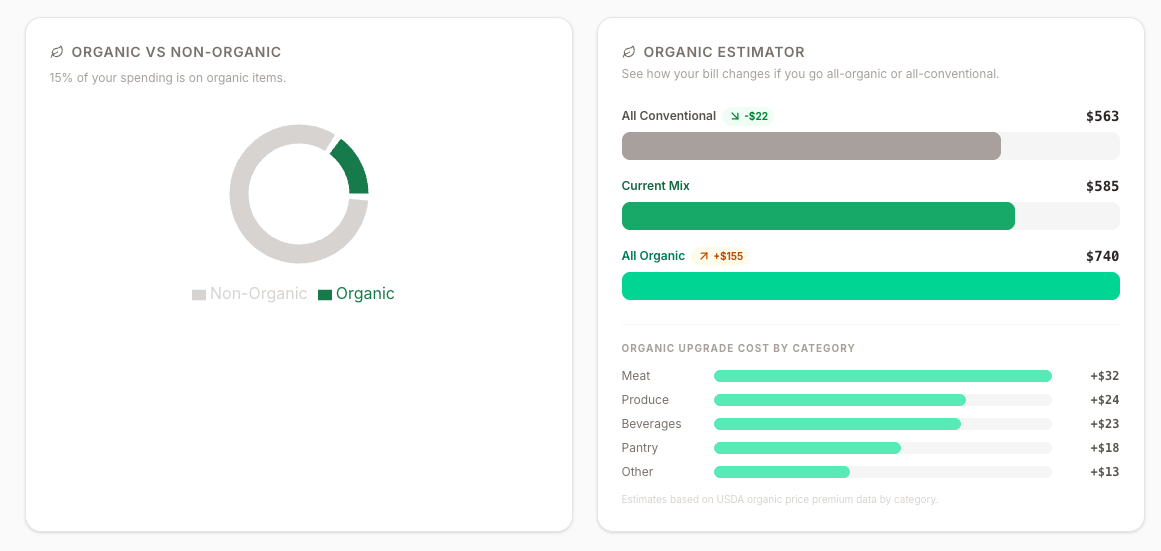
GroceryTrack's Organic Estimator — your actual spending, three scenarios, one dashboard.
The Annual Math
$465
All Conventional
Save $420/yr
$500
Current Mix
Baseline
$735
All Organic
+$2,820/yr
Knowing exactly how much more each category costs to go organic gives you a real basis for the Dirty Dozen decisions — you're not guessing at the premium, you're looking at your own numbers.
The Short Answer
Going all-organic isn't necessary, isn't proven to deliver across-the-board health benefits, and for most families would mean a significant and hard-to-justify increase in the monthly grocery bill.
A smarter approach: buy organic for the Dirty Dozen items your family eats most, buy conventional for the Clean Fifteen, and track what you're actually spending so you can see whether your choices are matching your priorities. That's not a compromise — it's just making a real decision with real information.
Your monthly grocery budget is finite. Spending it well means knowing where it's going.

Get started
Every new GroceryTrack account comes with a 30-day free trial of all Pro features—unlimited scans, full history, and advanced analytics. No credit card needed.
After the trial, basic features remain free. If you want the full experience, the Pro plan is available at $3.99/month for early adopters.
Start scanning
Sources: USDA ERS Organic Prices; USDA AMS Organic Market Reports; LendingTree/USDA Organic vs. Conventional 2024; EWG Dirty Dozen and Clean Fifteen 2026; Stanford University meta-analysis on organic nutrition (Annals of Internal Medicine, 2012); USDA Pesticide Data Program; Consumer Reports Organic Food Price Study.