The Secret Language of Produce Stickers (And Other Things Your Grocery Store Isn't Telling You)
You've peeled hundreds of those little stickers off apples, pears, and mangoes without thinking twice. But those stickers are actually a surprisingly information-dense system — and once you know how to read them, you'll never look at a piece of fruit the same way.
Here are a few things your grocery store knows about its produce that it never bothered to explain.
That Little Sticker Number Actually Tells You How It Was Grown
The number on your produce sticker is called a PLU code (Price Look-Up code). It's what a cashier uses to ring up loose produce — and it encodes more than just price.
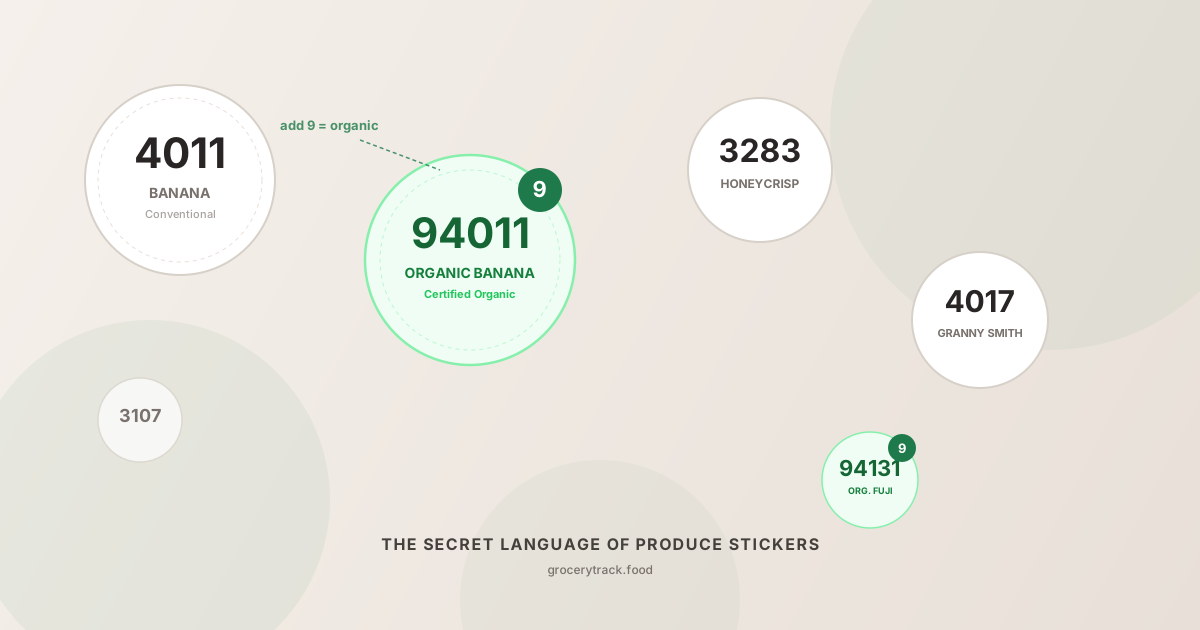
4-digit code (starts with 3 or 4): Conventionally grown
This is the standard. A banana sticker that says 4011 means it's a conventionally grown Cavendish banana. The 4011 code is famously the single most frequently scanned PLU in grocery store history. Every banana you've ever bought at a major chain has almost certainly had this number.
5-digit code starting with 9: Certified organic
This is the one worth memorizing. 94011 is an organic banana — same variety, grown without synthetic pesticides. The 9 is simply added to the front of any conventional code to indicate organic certification.
Standing in the produce aisle trying to remember whether you grabbed conventional or organic? Flip one over and look for the 9.
How to Read a PLU Sticker
The number on your produce sticker tells you how it was grown
Source: International Federation for Produce Standards (IFPS) — over 1,400 assigned PLU codes
What about 8? The GMO code that never happened
You may have heard that a 5-digit code starting with 8 means genetically modified. The International Federation for Produce Standards did reserve this prefix — but it was never adopted by the industry, and the IFPS officially retired the 8-prefix in 2015. You will never see one in a grocery store.
GMO labeling went in a different direction entirely — the National Bioengineered Food Disclosure Standard, signed into law in 2016 with the final rule published in 2018, now requires a separate BE disclosure symbol on qualifying products.
The number also identifies the specific variety
Beyond the organic/conventional prefix, the core digits identify the exact variety. 4131 is a large Fuji apple. 4017 is a Granny Smith. 3283 is a Honeycrisp. This is why produce departments can charge different prices for different apple varieties at the same checkout — the PLU routes to a specific price.
The full list is maintained by the IFPS and is publicly searchable. There are over 1,400 assigned codes.
The 4011 Banana You're Eating Isn't the Banana Your Grandparents Ate
Every banana you buy today is almost certainly a Cavendish. But before the 1960s, the dominant commercial banana was a completely different variety: the Gros Michel, also known as "Big Mike."
By most accounts, the Gros Michel tasted significantly better — sweeter, creamier, with a more intense banana flavor. There's a popular theory that artificial banana flavoring (isoamyl acetate) tastes nothing like a modern banana because it was based on the Gros Michel. The science is more nuanced — Gros Michel does contain higher levels of isoamyl acetate than Cavendish — but the idea that the flavoring was deliberately modeled on the old banana is unproven.
So what happened?
A soil fungus called Fusarium oxysporum f. sp. cubense — known as Panama disease — spread through commercial banana plantations across Central America, the Caribbean, and Southeast Asia throughout the early-to-mid 1900s. The Gros Michel had no resistance. The fungus persists in soil for decades, so once a plantation was infected, it was finished.
Through the 1950s and into the mid-1960s, the industry switched almost entirely to the Cavendish — a variety resistant to the strain of Panama disease (Race 1) devastating the Gros Michel. The Cavendish was widely considered blander in flavor, but it shipped well and could survive in the field. The entire global banana supply chain — shipping, ripening facilities, store shelf timing — was rebuilt around the Cavendish.
It's happening again
A new strain of the same fungus — Tropical Race 4 (TR4) — has been spreading through banana plantations in Asia, Africa, and the Middle East. In August 2019, it was confirmed in Colombia — its first detection in the Americas. The Cavendish has no resistance to TR4. There is no fungicide that effectively treats it. The FAO considers it one of the world's most destructive banana diseases.
Researchers are working on disease-resistant Cavendish variants including gene-edited versions, and some growers are experimenting with alternative cultivars like the Goldfinger (also known as FHIA-01), developed by Honduras's Foundation for Agricultural Research. But the 4011 Cavendish remains the world's most exported fruit by volume, and its long-term future is genuinely uncertain.
The next time you peel a banana, you're eating the backup plan from the last time this happened.
The Same Fruit Can Have Completely Different Names
Walk through the produce section of a Whole Foods, then a Costco, then a local Asian grocery store — you might walk past the same piece of fruit three times without recognizing it.
Meet the Sumo Citrus — or the Dekopon — or the Shiranui
That lumpy, oversized, easy-peel citrus with the distinctive topknot? In American stores, it's Sumo Citrus — a brand name trademarked by a California grower cooperative.
But the fruit was first bred in Japan in 1972, where it's called Dekopon (deko = bump, referring to the topknot; pon = from ponkan, one of its parent varieties). "Dekopon" is itself a trademark of JA (Japan Agricultural Cooperatives) — only fruit meeting specific sweetness standards can use the name. The formal cultivar name is Shiranui, after the area in Kumamoto Prefecture where it was first grown. In South Korea it's Hallabong, named after Hallasan mountain on Jeju Island.
Same fruit. Different names. Different prices.
One Fruit, Many Names
The same produce can have completely different names by store or region
This happens constantly:
- Champagne mangoes are also called Ataulfo, honey, or Manila mangoes — same variety, name varies by retailer and region
- Shishito peppers are sold as kkwari-gochu (꽈리고추) at Korean grocery stores
- Eggplant in America is aubergine in the UK, brinjal in India, melanzana in Italy, and nasu in Japan
- Dragon tongue beans are wax beans with purple stripes — the name is how specialty sellers justify a premium
- Cotton candy grapes are a trademarked name (owned by The Grapery) for a specific cross-bred cultivar
- Cara Cara oranges are sometimes just labeled "pink navel oranges"
The practical takeaway: if you find something at a specialty grocery store that you love, the same item might be sitting at a larger chain under a different name — and at a lower price.
Some grocery items only exist in certain countries
The differences go beyond naming. Some products are staples in one country and simply don't exist in another:
- Quark — a creamy dairy product between yogurt and cream cheese. Entire refrigerator shelves of it in German supermarkets. Most Americans have never heard of it.
- Clotted cream — thick, golden, 55%+ butterfat cream essential for a British cream tea. Almost impossible to find in U.S. stores because pasteurization requirements make it hard to produce at scale.
- Crème fraîche — ubiquitous in French supermarkets, only found in specialty sections in the U.S. at 3–4x the French price.
- Pandan leaves — used as widely in Southeast Asian cooking as vanilla in Western baking. Standard at Thai, Vietnamese, or Malaysian grocery stores. Absent from most American supermarkets.
- Nattō — fermented soybeans, a Japanese breakfast staple sold in packs of three for under $1. Available at Japanese grocery stores in the U.S., but unknown in most Western supermarkets. The sticky texture and strong smell make it polarizing even within Japan.
- Kefir — a fermented milk drink common across Eastern Europe and Central Asia. Increasingly available in U.S. health-food aisles, but niche compared to its ubiquity in Russian and Turkish grocery stores.
- Celeriac (celery root) — a winter staple in France and Germany for remoulade, soups, and purées. Available but uncommon in American stores.
- Wild rice stem (茭白, jiāobái) — Americans eat wild rice, the grain from Zizania palustris, an aquatic grass native to the Great Lakes. But in China, the related species Zizania latifolia is cultivated for its swollen stem — infected by a smut fungus (Ustilago esculenta) that prevents flowering and causes the stem to swell into a tender, mild-flavored vegetable. It's a common stir-fry ingredient sold fresh at any Chinese grocery store. Same genus, completely different food product, and they exist in entirely separate grocery ecosystems.
If you've moved between countries — or even between neighborhoods — you've probably experienced the disorientation of searching for a staple ingredient that simply doesn't exist in your new local store.
Reading this on your computer?
Email yourself the GroceryTrack app install link so it's waiting on your phone — no searching the App Store later.
One-time email. No newsletter, no spam.
Why Green Onions Taste Different Every Time
This surprises people because green onions seem like the most generic, interchangeable vegetable in existence. But they're not.
Soil changes flavor
All alliums pull sulfur compounds from the soil — and those compounds create the sharp, pungent flavor. High-sulfur soil = sharper onions. Low-sulfur soil = sweeter ones. This is why Vidalia onions from Georgia's low-sulfur soil are sweet enough to eat raw, while the same variety grown elsewhere is eye-wateringly sharp.
Green onions work the same way. A bunch from California's mineral-rich San Joaquin Valley can taste noticeably different from one grown in a humid coastal climate. The visual difference is zero. The flavor difference is real.
Soil Sulfur
High-sulfur soil = sharper, more pungent onions & garlic. Low-sulfur soil = sweeter (that's why Vidalia onions are sweet).
Variety
Scallions, spring onions, Tokyo negi, and ramps are all sold as “green onions” — different species, different taste.
Freshness
Green onions lose punch fast. Cut 2 days ago vs. 7 days ago = noticeable flavor difference. Farmers market wins here.
"Green onion" is a catch-all for four different things
- Scallions — Allium fistulosum, never forms a bulb. What most people mean by "green onion."
- Spring onions — a regular bulb onion (Allium cepa) harvested young. More pronounced bite.
- Tokyo negi — a Japanese variety with a longer, thicker white stalk. Slightly sweeter.
- Ramps — wild leeks, foraged in spring. Powerful garlic-onion flavor. Not really green onions at all.
Grocery stores rarely distinguish between these — they all go in the same bin.
Not All "Green Onions" Are the Same
Four different things — all labeled "green onions" at the store
If the green onions from your Asian grocery store taste different from the ones at the supermarket, there's a real reason: different supplier, different variety, or both.
Freshness matters more than you think
Green onions lose their punch fast. Two days post-harvest is noticeably more flavorful than seven. Farmers market green onions — picked within 24–48 hours — often have an intensity supermarket bunches can't match.
Herbs That Look Identical but Taste Nothing Alike
If you've ever grabbed the wrong bunch of herbs and only noticed mid-recipe, you're not alone.
Italian parsley vs. cilantro
The classic mix-up. Both have flat, bright green leaves with similar serrated edges, often shelved right next to each other. But crush a leaf and the difference is instant — parsley smells grassy and clean; cilantro smells sharp and citrusy (or soapy, if you carry the OR6A2 gene variant that affects roughly 4–14% of the population).
If your store doesn't label them clearly, the smell test is the only reliable way.
More look-alikes
- Dill vs. fennel fronds — both feathery and green. Dill: sharp, tangy. Fennel: anise/licorice. Not interchangeable.
- Thai basil vs. sweet basil — sweet basil (Genovese) has rounded, bright green leaves and wilts in heat. Thai basil has darker, narrower leaves with purple stems and holds up to cooking. Very different flavor profiles.
- Spearmint vs. peppermint — both labeled "mint." Spearmint is milder and sweeter (mojitos, tabbouleh, phở). Peppermint is sharper and more menthol (tea, desserts). Visually subtle — smell it.
- Curly vs. flat-leaf parsley — easy to tell apart visually, but many cooks don't realize flat-leaf has significantly more flavor. Curly parsley is mostly garnish.
When in doubt: crush a leaf and smell it before you bag it. Your eyes will deceive you; your nose won't.
One More: Sticker Color Sometimes Signals Ripeness
This isn't universal, but some producers use it. For kiwifruit, the sticker color can indicate ripeness stage at packing — green stickers for firmer fruit (longer shelf life), gold stickers for riper packs. Zespri, which dominates the New Zealand kiwi export market, uses a color-coded labeling system on some of their packaging.
Some banana distributors also use color-coded stickers internally to communicate harvest stage, though those signals have usually been abstracted away by the time the sticker reaches your store.
Why This Matters for Your Grocery Budget
Knowing PLU codes helps you spot organic produce at a glance. Knowing that the same fruit travels under different names helps you find better deals across store types. And knowing that produce quality varies by source, variety, and freshness helps you make better decisions about where to shop for the ingredients that matter most.
The grocery store is full of information it doesn't actively advertise. Once you start reading the stickers, you can't stop.

Get started
Every new GroceryTrack account comes with a 30-day free trial of all Pro features—unlimited scans, full history, and advanced analytics. No credit card needed.
After the trial, basic features remain free. If you want the full experience, the Pro plan is available at $3.99/month for early adopters.
Start scanning
PLU code data sourced from the International Federation for Produce Standards (IFPS). Panama disease and TR4 data from the FAO World Banana Forum. Shiranui/Dekopon history from USDA Agricultural Research Service records. Vidalia onion soil characteristics from the University of Georgia Extension. Cilantro taste genetics from Eriksson et al. 2012.