How Much Should You Spend on Groceries Per Month?
Updated March 2026 | Based on USDA, BLS, and Consumer Expenditure data
Groceries are one of those expenses that quietly eat your budget. You don't get a bill at the end of the month — the damage is already done, $7 at a time. So how much should you actually be spending?
The good news: there's real data on this, from sources that track it every single month.
What the USDA Says You Should Spend
The U.S. Department of Agriculture publishes four monthly "Food Plan" benchmarks — the closest thing to an official answer for "how much is a reasonable grocery budget?" Each tier represents a healthy diet at successively higher cost levels:
USDA Monthly Food Plans (Adult 20–50, in a 4-person household)
Source: USDA Cost of Food Reports, February 2026
Male
Female
- Thrifty Plan — Bare minimum. Requires cooking from scratch, strict meal planning, zero waste.
- Low-Cost Plan — Tight but doable. Store brands, seasonal produce, very little convenience food.
- Moderate Plan — The "average" tier. A mix of name brands and store brands, reasonable variety.
- Liberal Plan — Comfortable. More variety, more convenience, organic options.
The USDA also recommends adding ~20% if you're a single-person household — you can't buy in bulk as efficiently.
For Families
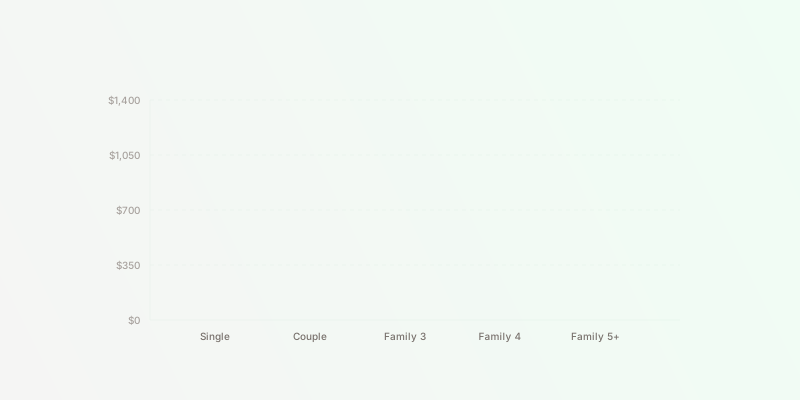
For a couple, the USDA moderate plan runs roughly $660–$780/month. For a family of four with two kids, expect $1,300–$1,450/month on the moderate plan, and around $975–$1,100/month if you're being thrifty.
| Household | Thrifty | Moderate | Liberal |
|---|---|---|---|
| Single adult | $249–313 | $331–392 | $422–479 |
| Couple (2 adults) | $500–560 | $660–780 | $840–960 |
| Family of 4 | $975–1,100 | $1,300–1,450 | $1,600–1,800 |
What Americans Are Actually Spending
The benchmark is one thing. Reality is another.
According to the BLS Consumer Expenditure Survey (2024), the average American household spends $6,224 per year on groceries — about $519/month. That's for the whole household, not per person.
A 2025 Popmenu survey found Americans reporting spending $235/week on groceries, which works out to roughly $940/month per household. That's noticeably higher than the BLS figure, likely because surveys capture what people think they spend (often higher than actuals, and inclusive of things like alcohol and household supplies).
Either way: most people are spending around or above the USDA's "moderate" benchmark.
Reading this on your computer?
Email yourself the GroceryTrack app install link so it's waiting on your phone — no searching the App Store later.
One-time email. No newsletter, no spam.
The Inflation Picture: 2025 Into 2026
Grocery prices have been a real headache. Here's where things stand based on the latest official data:
Grocery Inflation Snapshot
Source: USDA ERS Food Price Outlook, February 2026
What this means:If you spent $500/month on groceries in early 2024, you're likely paying $520–$540 today for the same basket.
- Categories with the biggest increases: processed fruits and vegetables, fish and seafood, pork, cereal and bakery products, and sugar and sweets.
- One bright spot: eggs dropped after a brutal stretch of price spikes.
How Much Should You Spend?
The USDA benchmarks are useful, but they don't account for your income. A commonly cited rule of thumb: spend 10–15% of your monthly take-home pay on groceries.
10–15% of Take-Home Pay Rule
Recommended grocery budget range based on monthly income
This fits within the classic 50/30/20 budget rule (groceries fall under the "needs" 50%).
If you're consistently spending above 15% of take-home on groceries alone (not counting restaurants), it's worth digging into why — whether that's household size, location, food waste, or shopping habits.
What Drives Your Grocery Bill Up (Or Down)
Household size
More people = more food, but per-person cost drops. A single adult on the moderate plan pays ~$430/mo; in a family of 4, that drops to ~$327/person.
Where you live
Hawaii residents pay ~33% more than the national average. Urban areas have higher costs from labor and logistics.
Food waste
The EPA estimates Americans waste $728/person/year in food they buy but never eat — over $60/month quietly disappearing.
Diet choices
Specialty diets (vegan, keto, gluten-free, organic-focused) consistently cost more than conventional options.
Practical Ways to Stay Within Your Target
- Track what you actually spend — most people genuinely don't know their real number. Scanning receipts is the fastest way to find out.
- Plan meals before shopping — shopping with a list consistently reduces impulse purchases.
- Buy store brands for staples. You won't notice the difference on pasta, canned tomatoes, frozen vegetables, or oats.
- Buy in season. Produce prices fluctuate wildly; out-of-season strawberries in January cost 2–3x more than peak-summer pricing.
- Use the USDA benchmarks as a sanity check. If you're a single adult male spending $800/month on groceries, you're well above even the Liberal plan ($479). That's a signal.
The Bottom Line
There's no single "right" number — it depends on household size, income, location, and what you value. But here's a reasonable framework:
Quick Reference: USDA Moderate Plan Baselines
Single adult
$330–$390/mo
Couple
$660–$780/mo
Family of 4
$1,300–$1,450/mo
Adjust by income: under 10% of take-home = room to breathe. Over 15% = look for leaks.
Track your actual spending for 2–3 months. Most people are surprised — usually upward. Knowing the real number is step one. Changing it is step two. GroceryTrack's grocery budget tracker does the tracking for you, straight from your receipts.
Data sources: USDA Food Plans — Cost of Food Monthly Reports (February 2026), USDA ERS Food Price Outlook (February 2026), BLS Consumer Expenditure Survey (2024), EPA — Estimating the Cost of Food Waste (2025)
Get started
Every new GroceryTrack account comes with a 30-day free trial of all Pro features—unlimited scans, full history, and advanced analytics. No credit card needed.
After the trial, basic features remain free. If you want the full experience, the Pro plan is available at $3.99/month for early adopters.
Start scanning