Where Do Americans and Canadians Actually Buy Groceries?
Ask someone where they buy groceries and you'll usually get one answer: "Walmart," or "I'm a Kroger family," or "Costco, obviously." It's a tidy story. It's also not quite true.
When we looked at real receipt data from GroceryTrack users — every store name our AI receipt scanner has cleaned up and matched, from national chains down to single-location farm stands — the picture that emerged was a lot messier than "everyone shops at one of five stores." Across our user base, people have scanned receipts from 149 distinct stores, spanning warehouse clubs, regional supermarkets, ethnic grocers, farmers markets, and even gas stations.
The 149-store landscape
A sample of the distinct stores GroceryTrack users have scanned receipts from, grouped by type.
National chains
Regional favorites
Ethnic & international
Farmers markets & stands
Convenience & beyond
That messiness, it turns out, matches what the broader data shows too. Here's what we found — and what it says about how Americans and Canadians actually shop in 2026.
The Big Chains Still Win — Just Not by as Much as You'd Think
Nationally, the math still favors the giants. Walmart holds roughly 20.4% of the U.S. grocery market in 2026 — down slightly from 21.1% in 2024. Kroger sits at about 8.3%, Costco has climbed to 8.2% (and is closing in fast), and Albertsons holds roughly 4.5%. Together, the largest handful of retailers still account for the majority of U.S. grocery spend.
U.S. grocery market share, 2026
Even the biggest grocer holds barely a fifth of the market. Source: Supermarket News.
That shows up clearly in our own data. Walmart, Costco, and Kroger — along with Kroger's regional banners like King Soopers, Ralphs, and Mariano's, and Albertsons' Jewel-Osco — are consistently among the stores significant enough to warrant their own dedicated store page on GroceryTrack. Trader Joe's, Whole Foods, Aldi, Target, Sam's Club, and Amazon round out the group of stores that show up again and again.
Notably, Costco's rise in the national numbers tracks with what we'd expect from our own users — bulk buying and membership warehouse shopping pair naturally with people who are already motivated enough to track their spending closely.
The Real Story Is the Long Tail
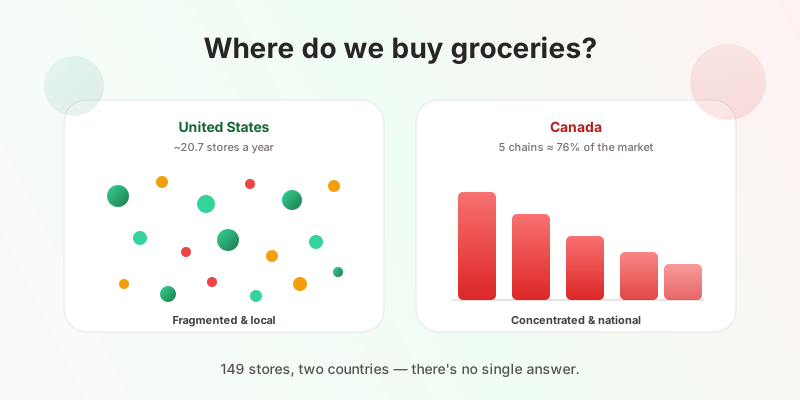
Here's the part that doesn't show up in market share reports: the average grocery shopper now buys from 20.7 unique retailers over the course of a year — up nearly 25% from 2019–2020. One-stop shopping is fading. People are splitting their grocery dollars across more places than ever.
Stores the average shopper buys from in a year
One-stop shopping is fading — shoppers now spread across roughly 25% more retailers than in 2019–2020. Source: Axios.
Our data backs this up directly. Of the 149 stores tracked, the majority aren't national chains at all — they're regional grocers with fiercely loyal followings: H-E-B in Texas, Wegmans in the Northeast, Food Lion and Piggly Wiggly in the Southeast, Schnucks and Heinen's in the Midwest, Market Basket in New England, and Weis Markets in the Mid-Atlantic. None of these will ever crack a national top-10 list, but in their home markets they're often the default choice — which is exactly why a single "where does America shop" answer misses so much.
Ethnic and International Markets Are a Bigger Part of the Picture Than You'd Guess
One of the more interesting patterns in our data: a meaningful chunk of the 149 stores are ethnic and international grocers. H Mart, Mitsuwa Marketplace, Tensuke Market, Joong Boo Market, Don Don Donki, Family Mart, Tai Nam Market, and Park To Shop all show up — alongside Eataly and Italian Centre Shop for European specialty goods, and Weee! for Asian grocery delivery.
This lines up with a habit most home cooks will recognize even if they've never thought about it explicitly: people don't pick one grocery store and stay loyal to it for everything. They shop their mainstream chain for staples, then make a separate trip — or a separate app order — to the specialty market for the ingredients that only show up there. It's one more reason why tracking spending by item, not just by receipt total, matters: a single week's grocery budget might legitimately span three or four very different stores.
Reading this on your computer?
Email yourself the GroceryTrack app install link so it's waiting on your phone — no searching the App Store later.
One-time email. No newsletter, no spam.
Farmers Markets Haven't Gone Anywhere
Despite the rise of delivery apps and 24-hour megastores, farmers markets and local produce stands are still very much part of the rotation. Our data includes Evanston Farmers Market, Green City Farmer's Market (and its Growing Home location), Local Greens, Fresh Farms, Garden Fresh Market, Sunset Foods, Bennett Farms, Dad's Farm Market, Buck Hill Market, Freestone Produce, and Giunta's Meat Farms.
For a lot of shoppers, this isn't an either/or choice. It's a Saturday farmers market run for produce and a Tuesday Kroger trip for everything else — two very different shopping experiences that both need to land in the same budget.
Canada Shops Differently — and Far More Concentrated
Cross the border and the picture changes substantially. Five companies control roughly 76% of the Canadian grocery market: Loblaw, Sobeys (Empire), Metro, Costco, and Walmart. Loblaw and Sobeys alone account for a huge share of that — Canada's grocery sector is one of the most concentrated in the developed world, especially compared to the more fragmented U.S. market.
Market concentration: U.S. vs Canada
Share of the grocery market held by the leading chains. Sources: Supermarket News, Statista.
Walmart, Kroger, Costco & Albertsons
Loblaw, Sobeys, Metro, Costco & Walmart
Our Canadian user data reflects that concentration: Real Canadian Superstore and No Frills (both Loblaw banners), Sobeys, Longo's, and Food Basics (a Metro banner) cover most of the activity. We also see something distinctly Canadian that rarely shows up in U.S. data — gas station grocery runs, with Petro-Canada and Shell Canada both appearing as places users scanned receipts. With fewer major grocery chains to choose from, the corner gas station fill-up-and-grab-a-few-things trip carries more weight north of the border.
Some Canadians Shop on Both Sides of the Border
There's another wrinkle worth calling out: plenty of Canadians don't shop exclusively in Canada at all. For years, Canadians have crossed the border for "star-spangled bargains" — driving to towns like Buffalo, Bellingham, or Plattsburgh, where the same cart of groceries often comes out noticeably cheaper, even after the exchange rate. In border communities, a U.S. grocery run is practically its own category of errand.
That habit has cooled off recently, though. Canadian trips to the U.S. dropped by roughly 25% in 2025 versus 2024 — about 10 million fewer trips, with car crossings down 30% — and the decline has carried into 2026. Some of that is the "Buy Canadian" sentiment that's reshaped retail north of the border over the past year; some of it is just less favorable currency and trade conditions.
Either way, it's a reminder that a household's grocery footprint doesn't always respect a national border — let alone a single store's loyalty program. A tool built around tracking spend at "the grocery store" needs to handle the fact that, for some shoppers, that might mean two countries and two currencies in the same month.
The Surprising Things People Track as "Groceries"
Not everything in the data is a grocery store in the traditional sense — and that's exactly the point. Petsmart, Dollar Tree, Binny's Lakeview, Lucky's Beverage World, and 85°C Bakery Cafe all show up, alongside gas-station convenience runs at BP, Esso 7-Eleven, Marathon, and Phillips 66.
Real household spending doesn't sort itself neatly into "groceries" and "everything else." Pet food, a bottle of wine, dollar-store paper towels, and a gas station snack all come out of the same monthly budget as the weekly Kroger haul — even if they technically come from different receipts and different store categories. This is exactly why a grocery expense tracker needs to handle more than one or two store formats. The real test of a tracking tool isn't how well it works at Walmart — it's whether it still works when you hand it a crumpled receipt from a farmers market stand or a gas station.
The Bottom Line
There's no single answer to "where do Americans and Canadians buy groceries" anymore — and there probably never really was one. Walmart, Costco, and Kroger still command the largest slice of national spending, but the typical shopper now spreads their grocery budget across regional chains, ethnic markets, farmers markets, and the occasional gas station run, often a dozen or more different stores a year. Canada's market looks different again — far more concentrated, with a handful of companies controlling the vast majority of sales.
What ties it all together is that grocery spending happens everywhere, not just at "the grocery store." A tracking tool that only understands one format misses most of how people actually shop.
GroceryTrack's AI receipt scanner is built to recognize and categorize receipts from all of it — from Walmart to a weekend farmers market stand — so your spending stays organized no matter where the receipt came from. For a closer look at where the money actually goes once it's tracked, see grocery spending by category.
Get started
Every new GroceryTrack account comes with a 30-day free trial of all Pro features—unlimited scans, full history, and advanced analytics. No credit card needed.
After the trial, basic features remain free. If you want the full experience, the Pro plan is available at $3.99/month for early adopters.
Start scanning
Sources: Supermarket News — Walmart grocery market share; Axios — the end of one-stop shopping; Statista — leading grocery retailers in Canada by market share; CBC — cross-border grocery shopping; RBC Economics — rebalancing Canadian cross-border travel.