Where Should You Store Groceries — And How Long Do They Actually Last?
You get home from the store, bags on the counter, and you're making a dozen small decisions without really thinking about them. Milk goes in the fridge. Bread goes... where, exactly? Do the tomatoes go in the crisper drawer or on the counter? Does ketchup actually need to be refrigerated, or is that just what the label says?
Most of us are running on habits we picked up from a parent or a roommate, not on anything we've actually verified. So we pulled shelf-life data for hundreds of the most commonly purchased grocery items in the US and Canada — sourced from the USDA/FDA FoodKeeper database — and looked for the patterns. Some of it confirms what you already do. A surprising amount of it doesn't.
The three storage zones, and the rule that actually matters
Before the specifics, one distinction explains most of the confusion: quality versus safety.
A lot of storage advice — especially the "refrigerate after opening" line printed on countless bottles — is about keeping food tasting its best for as long as possible, not about whether it's safe to eat. Shelf-stable condiments left on the counter after opening won't make you sick; they just won't taste quite as fresh as long. Meanwhile, raw meat, poultry, and dairy operate under different rules entirely, because bacterial growth is a real safety issue, not a quality one. Knowing which category something falls into changes how much you actually need to worry about it.
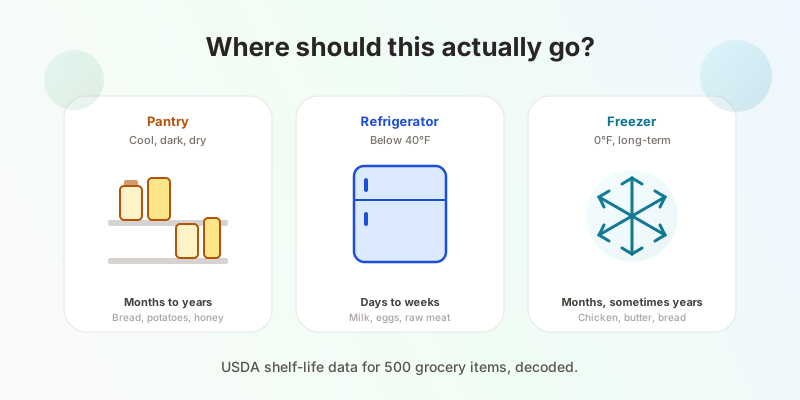
With that in mind, the three zones:
Pantry
Cool, dark, dry
Bread, potatoes, onions, honey, canned goods
Refrigerator
Below 40°F (4°C)
Milk, eggs, raw meat, opened condiments
Freezer
0°F (-18°C), long-term
Chicken, butter, bread, milk, ground beef
Pantry — cool, dark, dry storage for shelf-stable goods. Most pantry items last months to years, but "pantry" assumes room temperature, not a hot garage or a spot next to the oven.
Refrigerator — for anything that spoils at room temperature but doesn't need to be frozen for longer-term storage: dairy, most raw meat in the short term, opened condiments, and produce that's past its ripening stage.
Freezer — the most underused zone in most kitchens. Freezing doesn't just work for pre-frozen foods; it dramatically extends the life of things you'd normally think of as fridge-only, from bread to cheese to fresh herbs.
2 hrs
above 40°F (4°C)
The USDA's one hard safety rule that applies everywhere: don't let perishable food sit above 40°F for more than two hours (one hour above 90°F). Everything else is about quality, not safety. Source: USDA FSIS, "Danger Zone"
The simplest heuristic: look at where the store kept it
If you ever blank on where something goes and don't have this post open, there's a shortcut that works surprisingly well: think about where the grocery store displayed it.
Grocery retailers operate under the same food-safety regulations that apply to your kitchen — actually stricter versions of them, since they're inspected on it. A store isn't going to leave raw chicken or milk sitting on a dry shelf, and it isn't refrigerating bananas or storing potatoes in a cooler, because neither makes sense under the rules they have to follow. The eggs are in the refrigerated case. The deli meat is in the refrigerated case. The tomatoes, onions, potatoes, and bananas are out on a dry, unrefrigerated display table. That placement isn't arbitrary — it's the store's own food-safety and quality logic playing out in front of you, and it's usually a solid proxy for how to store the item once it's in your kitchen.
Two caveats keep this from being a complete substitute for the rest of this post. First, stores display unopened product — once you open something, the clock and the storage rules can change (that jar of pickles was shelf-stable at the store, but the "refrigerate after opening" label kicks in the moment you break the seal). Second, a few items get displayed for merchandising reasons more than storage logic — bagged salads and some pre-cut fruit sit in a refrigerated section at the store partly because it's already cut and partly because retail cold cases slow bacterial growth on convenience products; that part still applies at home, so it's not really an exception. As a first instinct when you're standing in your kitchen unsure, though, "how did the store have it" is a genuinely reliable gut check.
What "Best By" actually means (and why it's not an expiration date)
Before you can use any of the numbers in this post, it helps to know that the date printed on the package usually isn't a safety deadline at all — it's one of three different labels, and only one of them is even loosely about safety.
"Best If Used By"
Quality claim
Peak taste and texture, per the manufacturer. Not a safety cutoff (except infant formula).
"Sell By"
Note to the store
Tells staff how long to shelve it, so a shopper still has time to use it after buying.
"Use By"
Closest to a deadline
Still a quality recommendation, not a safety cutoff — except on infant formula, where it is.
None of these three labels are federally required or standardized (source: USDA FSIS Food Product Dating). Date-label confusion is estimated to cause ~20% of household food waste, per the USDA/FDA joint Request for Information (2024–2025).
None of these three labels are federally required, and none of them are standardized across manufacturers, which is exactly why the same wording means different things depending on what's printed underneath it. The USDA and FDA have both acknowledged the confusion is a real problem: in their joint 2024–2025 Request for Information on date labeling, both agencies cite estimates that date-label confusion accounts for roughly 20% of household food waste, mostly from people tossing food that was still perfectly fine because a "best by" date looked like a deadline.
The practical takeaway: for shelf-stable pantry items — crackers, canned goods, pasta, rice — the printed date is almost always about peak quality, not safety, and the guidance in this post (and the USDA FoodKeeper data behind it) generally extends well past it. For perishables — dairy, deli meat, raw poultry — treat the date as a more meaningful guardrail, but combine it with your own senses. If a carton of milk smells fine three days after its date, it's fine; if it smells off two days before, it isn't.
The produce that should never touch your fridge
This is where the data broke the most habits. A meaningful chunk of produce actually lasts longer — and tastes better — at room temperature.
Tomatoes are the clearest case: USDA guidance is pantry storage until ripe, then about a week on the counter. Refrigeration is explicitly called out as something that can dull the flavor. Once you understand why — chilling below about 54°F suppresses the genes for the enzymes that produce a tomato's flavor volatiles — the "never refrigerate a tomato" rule some people swear by makes a lot more sense.
Potatoes and onions both belong in the pantry, not the fridge, for one or two months. The reasoning is specific: refrigeration triggers "cold-induced sweetening" — potato starch converts to sugar below about 40°F, which gives cooked potatoes an odd, unpleasantly sweet taste and causes them to darken prematurely when fried.
Garlic keeps for about a month in the pantry as an unbroken bulb — refrigeration is only for individual peeled cloves, which spoil faster once separated from the bulb.
Bananas and avocados are counter items until ripe, then move to the fridge if you want to slow things down (the skin will darken, but the flesh holds). Trying to ripen them in the fridge just stalls the process entirely.
Bread is the one that surprises people most. Commercially baked bread keeps 14–18 days in the pantry, and homemade loaves last 3–5 days there. The fridge is explicitly discouraged: refrigeration speeds up staling through a starch reaction called retrogradation, which happens fastest in the 32–50°F range — squarely inside typical fridge temperatures. If you want to slow bread down for real, skip the fridge and go straight to the freezer.
Honey doesn't need refrigeration at all — pantry storage lasts about two years, and honey is one of the few foods that essentially never spoils if kept sealed and dry.
Reading this on your computer?
Email yourself the GroceryTrack app install link so it's waiting on your phone — no searching the App Store later.
One-time email. No newsletter, no spam.
The "refrigerate after opening" condiments that don't really need it
Ketchup and mustard both carry a "refrigerate after opening" label — and USDA's own guidance is blunt about why: "quality, not safety, is the reason the labels on these products suggest that they be refrigerated after opening." Both are acidic enough that bacteria struggle to grow in them regardless of temperature.
Refrigerated, ketchup holds peak quality for about six months after opening, and mustard closer to a year. Left in the pantry instead, expect the flavor to start fading sooner — roughly a month for ketchup, one to two months for mustard — but neither one spoils or becomes unsafe to eat. It's the difference between "still fine, just a little flatter" and "throw it out," not a difference between safe and unsafe.
Salsa is a different story worth flagging precisely because it looks similar: it's less acidic and holds more water than ketchup or mustard, so the "refrigerate after opening" instruction there is closer to an actual food-safety recommendation, not just a quality one. Worth actually chilling.
That doesn't mean refrigeration of ketchup or mustard is wrong — a cold squeeze bottle is genuinely a matter of taste for a lot of people. But if your fridge is packed and the mustard has to live in the pantry for a while, that's not a food safety risk.
Why your banana is aging your lettuce
Here's a mechanism most people have never heard of, even though it's shaping their crisper drawer every week: ethylene gas.
Some produce — apples, bananas, pears, peaches, melons, and ripening tomatoes among them — release ethylene as they ripen. Other produce is highly sensitive to it: leafy greens, broccoli, cucumbers, and berries in particular will spoil faster if they're stored near an ethylene producer. Store a banana next to your lettuce, and the lettuce is quietly aging faster than it needs to.
Ethylene Gas: Producers vs. Sensitive Produce
Store these two groups in separate crisper drawers. Source: UC San Diego Center for Community Health, Misfits Market
Releases ethylene
Sensitive to it
The fix is simple: keep ethylene producers and ethylene-sensitive items in separate crisper drawers, or at least separate areas of the fridge. It's a small habit that meaningfully extends the life of the more delicate, more expensive half of your produce drawer — the leafy greens and berries that spoil fastest and get thrown out most often.
Eggs: the one storage rule that changes at the border
If you've ever seen eggs stacked unrefrigerated on a shelf in a European grocery store and wondered if American supermarkets are being overly cautious, there's a real regulatory reason for the difference — and it's not really about the egg.
In the US, commercial egg producers are required to wash eggs before sale, which removes the natural protective coating (the cuticle) on the shell. Without that coating, the shell is more porous and more vulnerable to bacteria getting in, so refrigeration from farm to store to fridge is required. In much of Europe, eggs aren't washed, the cuticle stays intact, and hens are more commonly vaccinated against salmonella — so eggs are commonly sold and stored at room temperature. Same product, two different food-safety systems, two different storage rules.
For US eggs specifically: in-shell, they last 3–5 weeks refrigerated. Once cracked, raw whites and yolks last only 2–4 days, while hard-boiled eggs last about a week. None of these should sit out at room temperature for more than two hours once they've left the fridge.
The freezer buys you more time than you think
The freezer isn't just for things that arrived frozen. A lot of everyday fridge staples last dramatically longer once frozen — long enough to make "I'll never finish this before it goes bad" a solvable problem instead of an inevitability.
The Freezer Buys You More Time Than You Think
Source: USDA FoodKeeper
Commercial bread
Butter
Milk
Ground beef
Raw chicken
Ground coffee, opened
A few more worth knowing: hard cheese (cheddar, parmesan, swiss) holds for 6 months frozen, the same as refrigerated, so freezing is a genuine option if you won't get through a block in time. Ground beef at 3–4 months frozen versus just 1–2 days in the fridge makes the freezer the default for anything you're not cooking within a day or two of buying it. And raw chicken has one of the largest gaps between fridge and freezer shelf life of anything in the data, which says something about how often chicken gets tossed simply because a "this week" plan changed to a "next week" plan.
A quick-reference table for the items you actually buy
Shelf life below starts from the day of purchase, per USDA FoodKeeper guidance, and assumes normal, unopened storage unless noted.
| Item | Pantry | Fridge | Freezer | After Opening |
|---|---|---|---|---|
Milk | — | Use by date | 3 months | — |
Eggs, in shell | — | 3–5 weeks | Not recommended | — |
Butter | — | 1–2 months | 6–9 months | — |
Hard cheese (cheddar, parmesan) | — | 6 months | 6 months | 3–4 weeks |
Yogurt | — | 1–2 weeks | 1–2 months | — |
Commercial bread | 14–18 days | Not recommended | 3–5 months | — |
Bananas | Until ripe | 5–7 days | 2–3 months | — |
Apples | 3 weeks | 4–6 weeks | 8 months | — |
Potatoes | 1–2 months | 1–2 weeks | 10–12 months (cooked) | — |
Onions | 1 month | 2 months | 10–12 months | — |
Tomatoes | Until ripe | Not recommended | 2 months | — |
Avocados | Until ripe | 3–4 days | Not recommended | — |
Leafy greens / lettuce | — | 3–7 days | Not recommended | — |
Carrots | — | 2–3 weeks | 10–12 months | — |
Ground beef | — | 1–2 days | 3–4 months | — |
Chicken breast, raw | — | 1–2 days | 9–12 months | — |
Bacon | — | 1 week | 1 month | — |
Deli meat, sliced | — | 2 weeks | 1–2 months | 3–5 days |
Ketchup | 1 year | 6 months (opened) | — | 6 months |
Mustard | 1–2 years | 1 year (opened) | — | 1 year |
Honey | 2 years | — | — | — |
Peanut butter, commercial | 6–24 months | — | — | 2–3 months |
White rice | 2 years | — | — | 1–2 years (airtight) |
Dry pasta | 2 years | — | — | 1 year (pantry) |
Ground coffee | 1–2 years | — | 6–12 months | 1–3 months |
Frozen fries / hashbrowns | — | Not recommended | 12 months | — |
Shelf life starts from date of purchase, per USDA FoodKeeperguidance, and assumes normal, unopened storage unless noted. Ranges vary by brand and packaging — when in doubt, defer to the package's own date.
When the guidance still isn't enough
None of this replaces basic food safety judgment. Canned goods are safe well past their printed date as long as the can shows no dents, rust, or swelling. Anything perishable that's been sitting out above 40°F (4°C) for more than two hours should be thrown out, full stop, regardless of what a chart says. And when something looks, smells, or tastes off, the oldest rule still applies: when in doubt, throw it out.
What the data mostly clarifies is the boring middle ground — the tomatoes, the ketchup, the bread — where the instinct to refrigerate everything "just in case" actually works against you, either by wasting fridge space or by making food spoil faster than it would on its own.
Knowing where something belongs only helps if you notice it before it goes bad. GroceryTrack scans your receipts and shows you exactly what you've bought and how often — so if you're quietly buying a bag of spinach every week that never quite gets used, you'll see it in your history instead of finding it in the crisper drawer three weeks later.
The Pantry applies the same logic this post does. Freshness estimates are storage-aware and drawn from the same FoodKeeper guidance as the table above, so the same carton reads differently in the fridge and in the freezer — and moving an item recounts its life from the day you moved it, not from the day you bought it. And because a printed date is a quality estimate rather than a deadline, you can set your own best-by date on any item; yours always wins over ours.

Get started
Every new GroceryTrack account comes with a 30-day free trial of all Pro features—unlimited scans, full history, and advanced analytics. No credit card needed.
After the trial, basic features remain free. If you want the full experience, the Pro plan is available at $3.99/month for early adopters.
Start scanning
Sources: USDA/FDA FoodKeeper (shelf-life data); USDA FSIS, "Danger Zone" (40°F–140°F) (the two-hour rule); USDA FSIS Food Product Dating and the USDA/FDA joint Request for Information on date labeling (2024–2025) (date-label definitions and waste estimate); Ask USDA on condiment storage (ketchup/mustard "quality, not safety"); chilling-induced tomato flavor loss, PNAS; cold-induced sweetening in potatoes, Ask Extension; bread staling and retrogradation, Red Star Yeast; ethylene gas storage guide, UC San Diego Center for Community Health and Misfits Market; egg refrigeration differences between the US and Europe from NPR's The Salt and the ANSI Blog.