The Anatomy of a Grocery Receipt (and Why It Keeps Getting Longer)
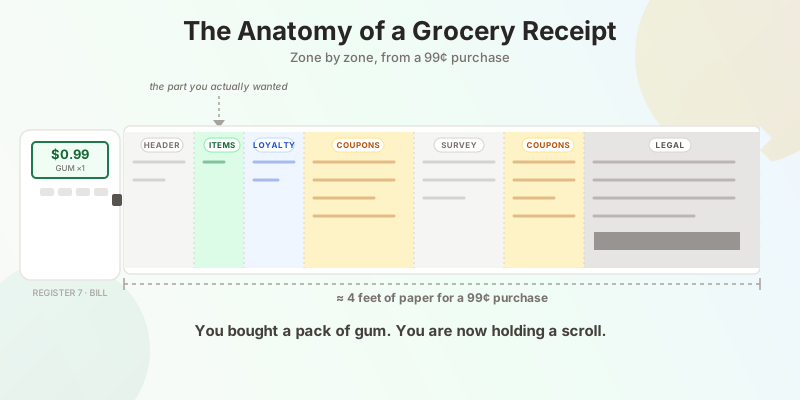
You bought a pack of gum. You are now holding a scroll.
Cartoonist Reza Farazmand nailed this in his Poorly Drawn Lines comic, "Anatomy of a Grocery Store Receipt": a 99-cent purchase at Bob's Food-N-Stuff produces a receipt containing the cashier's blood type, a survey disguised as a contest, an unpublished Ernest Hemingway story, a picture of a horse, a treasure map, and — of course — coupons, coupons, and more coupons. It's absurd. It's also barely an exaggeration. One CVS shopper famously got a nearly six-foot receipt for three items.
So let's dissect a real one. Zone by zone, top to bottom.
The anatomy
1. The header: store info you'll never use. Store name, address, phone number, store number, register number, cashier's name. Farazmand's version adds the cashier's age, marital status, and blood type — which is only funny because the real header already tells you more about "Register 7, Cashier BILL" than you ever wanted to know. This block exists mostly for the store's own bookkeeping and for returns.
2. The actual receipt. Here it is: the part you came for. Your items, cryptically abbreviated (WHP CRM CHS, anyone?), plus tax, total, payment method, and change. On a modern receipt this is often the shortest section — the comic's version is five lines in the middle of a four-foot document, and that ratio is about right. And even this section is padded: discounts, fees, and deposits all print as their own line items, so ten products can easily produce twenty lines. More on that below.
3. The loyalty ledger. Points earned, points available, member savings, "you saved $4.37 today!" This section is the receipt gently reminding you that the store knows who you are — and it's the engine behind everything below it.
4. The coupon zone(s). Not one block. Several, interleaved throughout, exactly as the comic depicts ("coupons... coupons... more coupons... free receipt with purchase"). These aren't random: they're generated at the register based on what you just bought and what you've bought before. Buy cat food, get a cat litter coupon. In Farazmand's world, buy milk, get "$1.00 off milk (cat milk only)."
5. The survey disguised as a contest. "Tell us how we did — WIN A GIFT CARD!" followed by, as the comic puts it, "several paragraphs of minuscule text detailing rules of survey disguised as contest." The tiny text is real: sweepstakes laws require disclosed odds, eligibility, and alternate entry methods, and all of it gets printed on every single receipt.
6. The legal footer. Return policy, coupon terms, barcodes for reprints, and the occasional "meaningless string of letters and symbols" — which is actually transaction metadata for the store's systems, not a treasure map. Probably.
Where the Length Actually Goes
Approximate share of a modern loyalty receipt, by zone — the part you came for is the smallest one
Decoding the fine print
The item list is where the receipt stops being a document for you and starts being a database dump. Here's what's actually behind the cryptic parts.
Abbreviated names aren't a cipher — they're a character limit
WHP CRM CHS isn't code. Receipt printers work with a narrow line of roughly 40 monospaced characters, part of which is reserved for the price column, and legacy point-of-sale systems capped item descriptions at 18–32 characters.
Those descriptions were typed by hand into the store's item database, often decades ago, by clerks inventing abbreviations on the fly with no style guide. Once entered, they're never revisited — nothing breaks if the entry from 1998 stays ugly, and cleaning up tens of thousands of SKUs benefits no one internally. The receipt is simply the one place customers see that internal database, which is why it reads like inventory shorthand, all in caps, because the old registers only supported uppercase and the convention stuck.
Why discounts print as their own line
Notice that a sale item doesn't just print at the sale price. The item scans at full shelf price — the only price the item record knows — and then a promotion engine posts each discount as its own negative line.
That's deliberate, for a few reasons. Accountants and loss-prevention teams need an audit trail showing exactly what was discounted and by which promotion; a silently reduced price would look like a mis-ring. Manufacturer coupons need a discrete record because the store bills the manufacturer back for each one redeemed. In some jurisdictions sales tax is calculated on the pre-discount price, so the original must stay intact. And if you return the item, the register needs to know which promotion to reverse. Bonus for the store: separate discount lines make your savings visible, feeding that "you saved $4.37 today!" flourish at the bottom.
Fees and deposits get their own lines too
The padding runs in both directions. Bag fees, bottle deposits (CRV in California), sweetened-beverage taxes, and local bottled-water taxes each print as their own line.
The reason is the same audit trail: these are amounts the store collects on behalf of a government or a redemption program, so they have to be tracked separately from the price of the goods. You can get a bottle deposit back, and regulators want fees itemized. Buy a 12-pack of soda in the wrong city and it can generate three lines — the soda, the deposit, and the beverage tax.
The wandering date
Farazmand labels his receipt with "date of purchase" followed by "day after date of purchase," and honestly, that's fair. The date and time are usually buried in the transaction metadata block — that cluster of numbers with store, register, transaction, and cashier IDs — because to the POS system the timestamp isn't information for you. It's part of the transaction's fingerprint for audits, returns, and reprints.
It can genuinely appear twice: the register prints one timestamp, and the card terminal — often a separate device with its own firmware — prints another, sometimes in a different format inches away. Where the date sits and how it's formatted varies wildly between chains, because no law standardizes it: it's whatever the receipt template defaulted to on whichever POS system the store happened to run — NCR, Toshiba, Oracle Micros, Square — plus decades of customizations that fossilized because returns processing and staff habits depend on the layout. MM/DD/YY at one store, DD-MM-YYYY at the next, a 24-hour timestamp at a third.
The tax code letters no one explains
Those single letters next to prices (N, X, T, F, O...) are tax-category flags. Sales tax isn't one rate: unprepared groceries are exempt or reduced-rate in most states, while prepared food, candy, soda, and general merchandise are taxed — often at different rates, which is why you may see "Tax 1" and "Tax 2" totals at the bottom. Each item's database record carries a flag telling the register which bucket it belongs to.
The catch: no retailer publishes an official key, and the same letter means different things at different chains. F is a food-rate item at Walmart, reportedly SNAP-eligible at Kroger, and FSA-eligible at CVS. Like the abbreviations, it's the register's internal tax table leaking onto paper.
The Letter Nobody Explains
The single letter next to a price is a tax-category flag — and it isn't standardized
Same letter, three chains
Common patterns you'll see (varies by retailer)
No retailer publishes an official key — the same letter can mean something different at the next register over.
The barcode is a database key
That block at the bottom (the comic's "optical illusion" was a barcode all along) is the transaction's ID in machine-readable form — store, register, transaction number, date. One scan at the returns desk pulls up your entire purchase from the store's database: what you bought, what you paid, which promotions applied. That's convenience and fraud prevention — the store trusts its database, not your paper.
The same scan powers exit-door receipt checks and reprints. It's rarely alone, either: each printed coupon carries its own barcode so it can be redeemed and tracked, and QR codes are increasingly replacing the stripes because they hold more data and can double as a link to your e-receipt or that gift-card survey. Naturally, the format — Code 128, Interleaved 2 of 5, QR — varies by chain, because of course it does.
Reading this on your computer?
Email yourself the GroceryTrack app install link so it's waiting on your phone — no searching the App Store later.
One-time email. No newsletter, no spam.
The one thing that got shorter: what the receipt legally can't show
For all its sprawl, there's exactly one line on the receipt the law forced to shrink: your card number.
Under FACTA — the Fair and Accurate Credit Transactions Act of 2003 (15 U.S.C. § 1681c(g)) — an electronically printed receipt handed to a cardholder may show no more than the last five digits of the card number and no expiration date. That's why yours reads **** **** **** 1234. The card networks' PCI DSS rules push merchants the same way, and the full card number, CVV, and PIN never print anywhere. (Your name, on the other hand, is fair game — it's embossed on the card anyway.)
The One Line the Law Made Shorter
FACTA (15 U.S.C. § 1681c(g)) caps what a printed receipt can show of your card
Full number + expiration date
Last 5 digits max, no expiration
Retailers learned this the expensive way. FACTA allows statutory damages of $100–$1,000 per willful violation, and every non-compliant receipt counts as a separate violation — so class actions got enormous fast. In Muransky v. Godiva Chocolatier, a receipt showing the first six plus last four digits led to an admitted 342,025 non-compliant receipts and a $6.3 million settlement.
That settlement didn't survive, though. The Eleventh Circuit threw it out in 2020, ruling en banc that extra digits without any actual harm wasn't a "concrete injury" sufficient for federal standing. Kamal v. J. Crew ended the same way in the Third Circuit — both decisions downstream of the Supreme Court's Spokeo v. Robins (2016), which held that a bare statutory violation alone doesn't get you into federal court. IKEA, Costco, Rite Aid, and Wendy's have all faced similar FACTA claims; IKEA alone settled for $24.25 million.
(A note on scope: this is FACTA territory, not the California Consumer Privacy Act. CCPA governs what stores do with the purchase data behind your loyalty card — not what's printed on the paper.)
So the modern receipt is a nice irony: four feet of coupons, sweepstakes rules, and tax codes, wrapped around the one field federal law made shorter.
The opposite problem: the receipt that says nothing
Now go to a farmers market and buy $34 of vegetables. The farmer taps an iPad, and you get a receipt — text message or email, or a slip barely three inches long — that says:
Hillside Farm · $34.00 · Card ····4821
That's it. No items. No quantities. Sometimes no tax line. The four-foot CVS scroll and this stub are opposite failures of the same system.
The reason is that item-level detail requires someone to have built a catalog. A grocery chain's receipt is verbose because a merchandising team spent decades entering 40,000 SKUs into an item database, each with a price, tax flag, and abbreviated name. A farmer selling what he picked Tuesday has no catalog — kale doesn't have a UPC, prices change with the weather, and half of it is sold by the handful. So he opens Square or Toast, types "34.00" into the keypad, and hits charge. The payment processor faithfully records exactly what it was given: an amount.
Cash makes it worse. A handwritten slip, or nothing at all — and no digital record anywhere.
This is a real gap, not just an aesthetic one. Business expense reports need itemization. Anyone tracking spending by category can log the $34 but not that it was produce. Anyone tracking what's in the fridge gets nothing at all. And the trend runs the wrong way: as more small vendors move to tap-to-pay tablets, the number of transactions with a clean digital trail but zero item detail keeps growing.
So the receipt landscape has two failure modes. Big retailers print far more than you need, wrapped around the part you actually want. Small vendors print far less. Neither produces something a human — or a program — can straightforwardly read.
Why is it getting longer?
The item list hasn't grown. Everything around it has. Four reasons:
Printing is essentially free. Receipts come off thermal printers — no ink, no toner, just heat on chemically coated paper. The marginal cost of another foot of paper is fractions of a cent. When extra length costs nothing, there's no economic pressure to be brief.
The receipt is the cheapest ad space a store owns. It's a printed message handed to a verified, paying customer at the exact moment of purchase — no postage, no ad buy. CVS's former chief marketing officer, Rob Price, said back in 2013 that the long receipts helped build a "personal connection" with shoppers, and retailers note that receipt marketing uses less paper than the direct-mail campaigns it replaces.
Loyalty programs turned receipts into personalized print-outs. This is the biggest driver. When you scan a loyalty card, the register appends offers tailored to your purchase history — no two customers get the same footer. The effect is dramatic and well documented: the same single item at CVS can produce a receipt of about 10.5 inches if you skip the card scan, or well over four feet if you use it. The receipt didn't get longer because you bought more. It got longer because the store knows you.
Same Store, Wildly Different Receipts
Length tracks the loyalty card scan far more than it tracks the cart
Source: CNN Business reporting on CVS ExtraCare receipts; widely reported six-foot, three-item receipt.
Legal and program text accumulates and never leaves. Survey rules, sweepstakes disclosures, return policies, coupon fine print — each addition is permanent. Nobody ever holds a meeting to remove a paragraph from the receipt.
Where it's headed
The backlash is real — CVS receipts became a full-blown meme, complete with Halloween costumes — and retailers responded not by printing less but by going digital: e-receipts, app-based coupons, and opt-outs that move the whole scroll to your phone. Which solves the paper problem and quietly makes the data collection even easier.
Until then, the receipt remains what Farazmand drew: a 99-cent transaction wrapped in four feet of marketing, legalese, and decorative thingies. And here's the thing the dissection reveals — a receipt isn't really a document format at all. It's thousands of stores' internal databases, tax tables, promotion engines, and decades-old template conventions, all happening to print onto the same width of thermal paper — or, at the farmers market, not printing much of anything. There's no standard for where the date goes, what the item names say, what the little letters mean, or whether the items appear at all. Anyone who's ever tried to read receipts systematically — expense apps, budgeting tools, receipt trackers — has learned this the hard way.
That's the exact mess our AI receipt scanner was built to sit on top of: it's trained to see through the forty-character abbreviations, the chain-specific tax-code alphabets, and the interleaved discount lines, so "WHP CRM CHS" comes out the other side as "Whipped Cream Cheese" in your dashboard — whether it came off a four-foot CVS scroll or a three-inch farmers-market slip.
Next time one curls out of the register, give it a proper dissection. Just don't expect to find the Hemingway story. That part they're still working on.

Get started
Every new GroceryTrack account comes with a 30-day free trial of all Pro features—unlimited scans, full history, and advanced analytics. No credit card needed.
After the trial, basic features remain free. If you want the full experience, the Pro plan is available at $3.99/month for early adopters.


Comic credit: Reza Farazmand, Poorly Drawn Lines.
Sources: CNN Business on CVS receipts, Reader's Digest, Nexstar: "Why are receipts so long now?", CNBC on CVS's digital-receipt fix, BookZero on Walmart tax codes, US Receipt Tax Codes dataset, PCVA Law on FACTA receipt suits, Alston on the 11th Cir. Godiva ruling, Lexology on Kamal v. J. Crew.