How a Product Recall Actually Works at Your Grocery Store
You get a text: "Recall alert: please check your recent purchases for [product]." Somewhere in the last two hours, a bag of spinach you bought last week quietly became a problem the store already knew about before you did. Here's the machinery behind that text.
Step 0: Finding the problem before anyone knows what caused it
Before any recall exists, someone has to figure out that there is a problem — and this stage can take weeks, with no product named at all.
A live example: as of July 14, 2026, CDC is tracking a multistate cyclosporiasis outbreak — more than 400 confirmed cases across Michigan, Ohio, West Virginia, and Kentucky, with illnesses starting around June 22. CDC's own summary is blunt about where things stand:
A specific food item has not yet been confirmed as the source.
No recall. No implicated brand. No store has been notified of anything, because investigators don't yet know what to tell them.
Here's the chain that has to complete before Step 1 (below) can even start:
-
Case reporting. Doctors diagnose the illness (a stool test, for cyclosporiasis) and report it up through local and state health departments to CDC. This is slow by nature — CDC notes the real number of sick people is almost certainly higher than reported, since many people recover without seeing a doctor and are never tested.
-
Recognizing it's one outbreak, not many unrelated illnesses. For bacterial pathogens like Listeria or Salmonella, CDC's PulseNet network compares DNA fingerprints (increasingly via whole-genome sequencing) to link cases across states. Cyclospora is a parasite, not a bacterium, and its genetic subtyping is less developed — which is part of why this outbreak is leaning more heavily on interviews than lab matching to find the common thread.
-
The food history interview. This is the exact stage the outbreak is in right now. Health officials ask sick people what they ate over the prior one to two weeks, then look for the one food that shows up disproportionately across patients in different states who've never met each other. History is a clue here too: past U.S. cyclosporiasis outbreaks have repeatedly traced back to imported fresh produce — cilantro, basil, pre-packaged salad mix — so investigators are almost certainly weighting their questions that way.
-
Traceback. Once a suspect food emerges from the interviews, FDA and state investigators work backward through receipts, loyalty-card purchase histories, and restaurant invoices from the sick patients, cross-referencing supplier and distribution records until every case leads back to one common farm, processor, or lot.
-
Only now can a recall exist. The specific lot number, plant code, and date range in a recall notice (the fingerprint described in Step 2) is the output of this whole traceback chain — not something a grocery store or manufacturer knew on day one.
Before Any Recall Can Exist
Five stages, in order — the multistate cyclosporiasis outbreak below moved through all five in about three weeks
Doctors diagnose the illness and report it up through local and state health departments to CDC.
PulseNet DNA fingerprinting for bacteria — or, for parasites like Cyclospora, leaning on interviews instead.
Sick patients are asked what they ate over the prior 1–2 weeks, looking for one food in common.
Investigators work backward through receipts and distribution records to one farm, processor, or lot.
A specific lot number, plant code, and date range can finally be named.
Doctors diagnose the illness and report it up through local and state health departments to CDC.
PulseNet DNA fingerprinting for bacteria — or, for parasites like Cyclospora, leaning on interviews instead.
Sick patients are asked what they ate over the prior 1–2 weeks, looking for one food in common.
Investigators work backward through receipts and distribution records to one farm, processor, or lot.
A specific lot number, plant code, and date range can finally be named.
Source: CDC, multistate cyclosporiasis outbreak, July 2026 — case count and source confirmation as reported July 14–28.
Update, July 28, 2026: This is exactly what happened. On July 17 — three days after the "no source confirmed" update above — investigators traced the outbreak to iceberg lettuce, and Taylor Farms de Mexico recalled all iceberg lettuce sourced from central Mexico. By the time this posts, the confirmed cluster tied to that lettuce (surfaced through Taco Bell exposure) has grown to nearly 2,000 cases across nine states, with roughly 100 hospitalizations, and CDC's broader national tally sits above 4,000 confirmed cases with thousands more pending review. It took about three weeks from symptom onset to a named product — a useful real-world yardstick for the rest of this post: everything below, the two-hour shelf sweep, the UPC block, the loyalty-card text message, is the fast part. The slow, uncertain part happens first, and it happens to thousands of sick people before it happens to a single bag of lettuce on a shelf.
Step 1: The recall starts before the store hears about it
Almost all food recalls are voluntary — a company or its regulator identifies a problem (contamination, mislabeling, an undeclared allergen) and the manufacturer pulls the product itself, before any store gets a government notice. Meat, poultry, and egg products fall under USDA's Food Safety and Inspection Service (FSIS); everything else — produce, packaged foods, seafood — falls under the FDA. Both agencies classify the severity:
- Class I — reasonable probability the product causes serious health consequences or death. The E. coli-in-lettuce, undeclared-peanuts kind of recall.
- Class II — may cause temporary or reversible harm, or the odds of serious harm are remote.
- Class III — violates a regulation but isn't expected to hurt anyone (wrong label, missing net weight).
Not All Recalls Are the Same Emergency
FDA and USDA both classify recalls by severity, most urgent first
Reasonable probability the product causes serious health consequences or death.
E. coli in lettuce, undeclared peanuts
May cause temporary or reversible harm — or the odds of serious harm are remote.
Minor contamination below a risk threshold
Violates a regulation but isn't expected to hurt anyone.
Wrong label, missing net weight
Crucially, retailers usually hear about a problem from their own supplier or distributor before it becomes a public FDA/USDA notice — manufacturers are contractually and legally obligated to notify the retailers they shipped to directly. The public alert on FoodSafety.gov often comes second, not first.
Step 2: The store gets an alert that's oddly specific
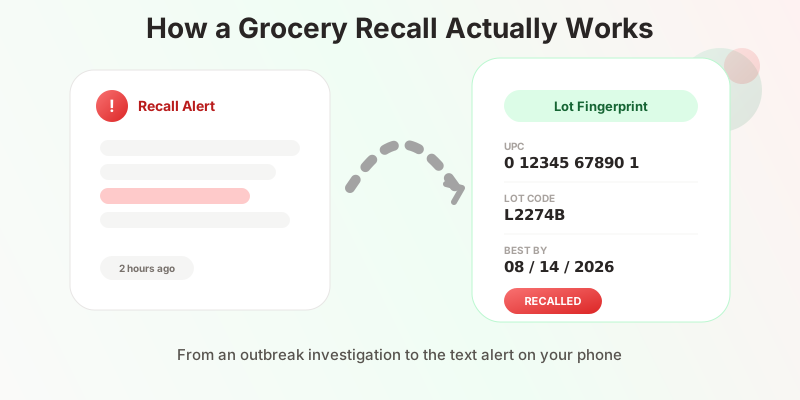
A recall notice isn't "stop selling all yogurt." It's a precise fingerprint: brand, product name, size, UPC, lot or batch code, and a "best by" or "use by" date range, sometimes down to a specific manufacturing plant number. That specificity matters both ways — if even one field doesn't match your package, the product isn't actually part of the recall. Modern traceability (electronic shipping records, lot-level scanning) is why recalls have gotten more surgical over time: a single lot from a single field can be pulled, rather than every bag of spinach a chain sells nationwide.
This is also why the FDA's Food Traceability Rule (FSMA 204) exists: it requires anyone handling a specific list of higher-risk foods — leafy greens, melons, tomatoes, fresh-cut produce, certain shellfish and finfish — to record and share detailed tracking data at every step, precisely so that when something goes wrong, the recall can isolate one lot instead of an entire category. It was originally supposed to take effect in January 2026; the FDA has since pushed the compliance deadline to July 2028, but the underlying idea — every case of spinach traceable back to the field it grew in — is already how the largest chains operate.
Reading this on your computer?
Email yourself the GroceryTrack app install link so it's waiting on your phone — no searching the App Store later.
One-time email. No newsletter, no spam.
Step 3: The scramble — pulling it from everywhere at once
Once a store's central office receives the notice, it fans out fast, and stores are typically expected to clear shelves within about two hours. But "the shelf" is only one of several places the product might be sitting:
- the sales floor
- the backroom stockroom
- a truck still in transit from the distribution center
- the distribution center itself, in cases not yet shipped
Employees physically walk the aisles pulling matching UPCs and lot codes, and many retailers additionally block the recalled UPC at the register — so even if a unit gets missed on the shelf, it simply won't scan or sell at checkout. Recalled containers are typically marked so nobody restocks them by mistake, and the product gets quarantined, then returned to the distributor or destroyed, depending on the manufacturer's instructions.
Step 4: Telling you — and the limits of how
This is where your receipt (or loyalty card) becomes a recall tool. If you used a loyalty card or membership number for the purchase, the store can query its own sales records — the same database that generates your itemized receipt — for every account that bought that UPC and lot in the affected window, and reach out directly: email, app push notification, text, or in some cases an automated phone call. In a review of major U.S. grocery chains, PIRG found that 58% had some kind of program to directly notify customers of a recall by email or phone — though most didn't publicly explain when it kicks in, how to sign up, or what it covers. Costco, Kroger, Walmart, Target, and Whole Foods all run some version of this; Costco in particular is known for getting detailed recall notices to affected members before the public announcement even goes out.
The catch is that this only works within its own boundaries: it reaches you only if you used the loyalty account for that specific purchase, only if the store has current contact information on file, and only for that one retailer — it doesn't reach cash customers, guest checkouts, or anyone who shopped without scanning a card. That's a real gap for exactly the kind of transaction that leaves no item-level trail at all: farmers-market and other card-less, unitemized purchases leave no trail a recall system could ever query.
Because of that gap, direct notification is a supplement, not a substitute, for the public system: FoodSafety.gov and FSIS.usda.gov aggregate every active FDA and USDA recall in real time, and that remains the only channel that reaches everyone regardless of where or how they shopped.
Who a Loyalty-Card Recall Alert Actually Reaches
A real tool, with real edges — it only works within its own boundaries
- You used a loyalty card or membership number for that exact purchase
- The store has current contact info on file
- You bought it at that same retailer
- Cash purchases and guest checkouts
- A different retailer than the one that flagged it
- Stale or missing contact info on the account
PIRG found 58% of major grocery chains have some kind of direct recall-notification program — but most don't publicly explain how it works. Only FoodSafety.gov and FSIS.usda.gov reach everyone, regardless of where or how they paid.
The Fast Part
Once a recall exists, everything below happens in hours — the investigation that got here took weeks
Supplier or distributor tells the store directly, ahead of any public notice.
Matching lot codes pulled from the floor, backroom, and trucks; the UPC stops scanning at checkout.
FoodSafety.gov and FSIS.usda.gov publish the notice — the one channel that reaches every shopper.
Only for accounts that scanned a card for that exact purchase, at that retailer.
Why this connects back to the receipt
All of this — the lot codes, the UPC blocking, the itemized purchase history that lets a store find you specifically — depends on the exact same infrastructure that makes a grocery receipt absurdly long: an item-level database tying every purchase to a specific SKU, lot, and customer account. The four feet of coupons and the two-hour recall pull are the same system pointed at different goals. It's also exactly why a receipt-less cash purchase, or an unitemized farmers-market charge, is invisible to a recall system in a way an itemized, loyalty-linked grocery purchase is not.
What you can actually do as a household
Given everything above, a few things actually move the needle:
Don't rely on any single store's alerts as your only source. Loyalty notifications only cover what you bought at that one retailer. Subscribe directly to the two government feeds that cover everything regardless of where you shopped: FoodSafety.gov (FDA-regulated food) and FSIS's recall alerts (meat, poultry, eggs) both offer free email or text subscriptions — the only channels that reach you no matter which store, or which card, you used.
Keep receipts, or photos of them, for a few weeks — especially for produce, deli, and frozen items. Those categories are recalled most often. A receipt gives you the purchase date and store, which is exactly what you need to check against a lot code or "sold between" date range in a recall notice. This is the practical payoff of an itemized receipt: it's a searchable record. A card-swipe stub with no items on it isn't.
Check before you toss the packaging. What's actually being recalled is a specific lot code, UPC, and "best by" date — not just the brand. Once the package is in the trash, you have no way to verify whether your specific unit matches.
When you hear about an outbreak in the news — before any recall exists — hold onto suspect items rather than tossing them immediately. Early in an investigation, like the cyclosporiasis outbreak described above, there's no specific product to check yet. But if anyone in the household has matching symptoms, keeping the item (refrigerated or frozen) along with its packaging gives your doctor and local health department something to test — you become one of the interview subjects that helps traceback move faster.
Treat Class I recalls with more urgency if your household includes infants, elderly, pregnant, or immunocompromised members. Check the fridge, freezer, and pantry that day rather than "next time you're near the trash."
Get started
Every new GroceryTrack account comes with a 30-day free trial of all Pro features—unlimited scans, full history, and advanced analytics. No credit card needed.
After the trial, basic features remain free. If you want the full experience, the Pro plan is available at $3.99/month for early adopters.


Sources: FSIS — Understanding Food Recalls, Grocery Dive — What grocery stores do when recalls happen, Grocery Dive — The new era of food recalls, Food Poisoning News — Do loyalty apps know about recalls, PIRG — Food Recall Failure, FDA — FSMA 204 Food Traceability Rule, FoodSafety.gov — Recalls and Outbreaks, CDC — Cyclospora Outbreak Linked to Iceberg Lettuce, CDC Newsroom — Outbreak expanded to four new states, Infection Control Today — July 14 investigation update, CDC — PulseNet Fast Facts.