Grocery receipt codes: what the letters next to each price mean
The single letter printed after a price on a grocery receipt, such as F, T, N, X, A, B or E, is a flag from the store's register. It almost always answers one of three questions: is this item taxed, can it be bought with SNAP benefits, or can a health spending card pay for it.
There is one catch. We could not find a key published by any large grocery chain, and the same letter means different things at different stores. An F at Kroger is reported to mark food you can buy with SNAP. An F at CVS is reported to mark an item your FSA card covers.
This guide covers what each kind of flag is for, what the letters are reported to mean at the big chains, and a two-minute check that decodes any receipt, including one from a store that is not listed here.
What do the letters on a grocery receipt mean?
Each item in a store's database carries a few yes-or-no settings. The register needs them to work out the total, and the receipt prints them as letters.
Is this item taxed, and at which rate?
The register has to add up each tax rate separately, so every item carries a tax bucket.
Letters often used: T, X, A, B, N, E, H, G
Can this item be paid for with food benefits?
Federal rules define which foods qualify, and food bought with SNAP cannot be taxed.
Letters often used: F, B, FS
Can a health spending card pay for this item?
The standard for health benefit cards calls for eligible items to be flagged on the receipt.
Letters often used: F, H, FX, +
The letters overlap because every chain picked its own. F can stand for food, food stamps or FSA. T usually stands for taxable. N usually stands for non-taxable. X, A, B and E are tax buckets that mean whatever that chain's register says they mean.
Some receipts print two letters on one line. That is two flags at once, for example a food that qualifies for SNAP and is also taxed.
Why does a receipt need tax letters at all?
Sales tax on groceries is not one rate. Most US states do not tax unprepared food. When the Tax Foundation counted in 2022, 13 states taxed groceries, seven at the ordinary rate and six at a reduced one, and some of those have cut or ended the tax since. Inside one store, a loaf of bread, a hot rotisserie chicken, a bottle of soda and a roll of paper towels can fall under different rules.
The register adds up each tax rate separately. That is why you sometimes see two tax lines at the bottom, such as TAX 1 and TAX 2. The letter on each item tells the register which pile it belongs in.
Canada works the same way with different words. The Canada Revenue Agency treats basic groceries as zero-rated, which means taxed at 0%. Its guidance on basic groceries lists the exceptions that are taxed, including carbonated beverages, candy, snack foods such as chips, and most drinks sold as a single serving under 600 mL. So a Canadian receipt marks the taxed lines and leaves the rest alone.
What does F mean on a grocery receipt?
F is the letter with the most meanings, so it depends on the store.
- At a supermarket, F most often marks food that qualifies for SNAP. Federal rules define eligible food as any food intended for human consumption, except alcohol, tobacco and hot foods prepared for immediate consumption (7 CFR 271.2). The register has to know which items qualify so an EBT card pays only for those.
- At some chains F marks a food tax rate. In a state with a lower rate for groceries, F can simply mean "taxed at the food rate".
- At a pharmacy counter, F often marks an FSA or HSA item. SIGIS, the industry group that sets the standard for health benefit cards, requires merchants using its system to flag eligible items on the receipt when one of those cards is used. PeopleKeep, a benefits administrator that reviews receipts for claims, lists an F at CVS and at Costco. Its list shows other stores using other marks for the same thing: FX at Kroger-owned stores, H at H-E-B, Rite Aid and Sam's Club, and a plus sign at Target.
The SNAP flag and the tax flag are linked. Federal rules say that food paid for with SNAP cannot be taxed (7 CFR 272.1(b)). Soda is the usual example. Some states tax it, and it has long qualified for SNAP. So the register needs to know both facts about a bottle of soda: tax it for a card payment, and do not tax it when SNAP pays. That is why some chains have a letter for "food, and also taxed". At Kroger that letter is reported to be B, though that reading is less well sourced than the F.
These flags also change. By August 2026, 23 states had federal approval to stop SNAP from covering items such as soda and candy, according to Grocery Dive, and in June a federal judge ruled against five of those approvals. Where a restriction is in force, the soda loses its SNAP flag and keeps its tax flag.
What does T mean on a grocery receipt?
T almost always means the item was taxed. It shows up next to things like paper goods, cleaning supplies, pet food, alcohol, and in many states candy, soda and hot prepared food.
If you searched for what T means on an ACME, Safeway or Albertsons receipt: we could not find a dependable published key for those stores, and "taxed" is the most likely reading. You do not have to take that on trust. The check in the next section confirms it from your own receipt.
N is the usual opposite: not taxed. At Walmart the commonly reported pair is N for not taxed and X for taxed. At Costco shoppers report A for taxed and E for exempt.
How do you decode the letters on your own receipt?
The receipt already contains its own answer key, because the tax printed at the bottom has to equal the tax on the flagged items.
- Find the tax lines. Look just above the total. Note each tax amount and its rate. Some chains print the rate, and some print the key itself. Sobeys in Canada, for example, prints its tax line as HST 1, matching the 1C on taxed items.
- Add up the items that share a letter. Start with the letter you suspect means taxed.
- Multiply by the rate. If the result matches the printed tax, you have found the taxed letter. If it is short, another letter is taxed too.
- Everything left over is untaxed. Those letters mark exempt food, or a flag that has nothing to do with tax.
- If you paid with EBT, check the SNAP subtotal. The items it covers share the SNAP letter.
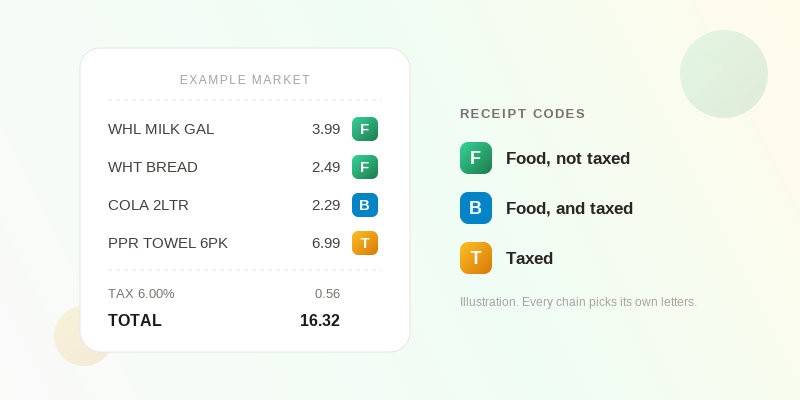
EXAMPLE MARKET #0412
- WHL MILK GAL3.99 F
- WHT BREAD2.49 F
- COLA 2LTR2.29 B
- PPR TOWEL 6PK6.99 T
SUBTOTAL15.76
TAX 6.00%0.56
TOTAL16.32
Working it out
Tax printed: $0.56 at 6%. So about $9.28 of the trip was taxed.
B + T lines: 2.29 + 6.99 = 9.28. That matches.
F lines: 3.99 + 2.49 = 6.48, and none of it was taxed.
So at this store F is untaxed food, T is a taxed item, and B is a food that is also taxed.
Two things can throw the arithmetic off by a few cents. Stores usually round tax once on the taxed subtotal, not on each item. And a store discount usually lowers the taxed amount, so use the price after the discount line.
What do the letters mean at Walmart, Kroger, Costco, Target and ACME?
This table is a starting point, not a decoder ring. We found no key published by any chain in it, the guides that exist contradict each other, and a store can use different letters in different states. We marked how good the evidence is for each row.
| Chain | Letters and reported meaning | Evidence | Note |
|---|---|---|---|
| Walmart |
| Reported | N and X are the two letters guides agree on. Different tax rates print as TAX 1, TAX 2 and so on at the bottom. |
| Kroger and its banners |
| Reported | F is attributed to benefits administrators, and FX comes from one. B and T come from guides we could not trace to a source. Kroger has confirmed none of it. |
| Costco |
| Reported | A and E are shopper observations, and F comes from one benefits administrator. The same item can be E in one state and A in another. |
| CVS |
| Reported | Listed by a benefits administrator and by receipt guides. Here F is a health-spending flag and says nothing about tax. |
| Target |
| Disputed | T and the plus sign come from one benefits administrator. The longer keys come from a single publisher and do not agree with each other. |
| Albertsons family (ACME, Safeway, Vons, Jewel-Osco) |
| Not found | We found no dependable key for these stores. T as "taxed" is the common convention, and the check below takes two minutes. |
One public dataset gives a single meaning per letter across fifteen retailers. It does not say where its meanings come from, and it disagrees with the other guides on several letters. It lists X as a tax-exempt transaction, while two guides list X as the taxed item at Walmart. Where only one source gives a meaning, the table says so.
What about receipts in Canada?
At several Canadian chains the letters name the tax: H for HST, G for GST, P for PST. At Loblaw stores, Costco and Metro, an H means HST was charged, and no letter, or a cluster without an H, means the item was not taxed. Other chains use letters that name nothing. Walmart Canada marks taxed items J or A.
| Chain | Taxed item | Untaxed item |
|---|---|---|
| Loblaw banners (Loblaws, No Frills, Superstore, Zehrs) | Any cluster with an H, such as H or HMRJ. In the west, clusters with G or GP | Clusters without an H, such as MRJ or RQ |
| Costco Canada | H (HST), G (GST), GP (GST and PST) | No letter |
| Walmart Canada | J and A | D |
| Sobeys | 1C | C on its own |
| Metro | H | No letter |
| Safeway (BC, Saskatchewan) | BC (GST and PST), GR (GST only) | C on its own. R marks a bottle deposit |
The same warning applies north of the border. C on its own means untaxed at Sobeys, and BC means both taxes at Safeway in British Columbia. At Walmart Canada, Crowcery found that an H does not mean HST at all.
What are the other codes on a grocery receipt?
Letters after the price are only one kind of code. These are the others people ask about.
- Abbreviated item names. WHP CRM CHS is whipped cream cheese. The names are short because old registers capped descriptions at a few dozen characters. Our guide to the anatomy of a grocery receipt explains where they come from.
- Weight and quantity lines. A line like
1.24 lb @ 2.99/lbor2 @ 3/5.00is the math behind the price printed next to it, not a separate charge. - Deposit lines. A bottle deposit prints as its own line. In California it is labeled CRV, which is 5 cents for containers under 24 ounces and 10 cents for 24 ounces or more, according to CalRecycle.
- Coupon codes. SC is commonly a store coupon, and MC or MFR a manufacturer coupon. Each prints as a negative line under the item.
- Costco's TPD and IRC. These are reported to mark a Costco-funded markdown and a manufacturer-funded instant rebate. Costco has not confirmed either.
- The row of numbers at the bottom. On a Walmart receipt, ST#, OP#, TE# and TR# are commonly read as store, operator, terminal and transaction numbers. Together they identify the purchase for a return.
Is there an official list of receipt codes?
Not that we could find. We looked for a key published by Walmart, Kroger, Costco, Target, Albertsons and the large Canadian chains and did not find one. The letters are internal settings from each chain's register software that happen to print on paper.
Two parts of the system are written down. The rules behind the flags are public: which foods qualify for SNAP, that SNAP purchases are not taxed, and that the health benefit card standard calls for eligible items to be flagged. The letters each store picked for those rules are not.
That is also why the check above is worth knowing. A guide like this one can go stale when a chain changes its registers. The arithmetic on your own receipt cannot.
Do you need to read the codes to track your spending?
Not really. The letters matter when you are checking a tax charge, filing an FSA claim, or working out what your EBT card covered. For knowing what you spent and on what, the item names and prices are the part that counts.
That is the part GroceryTrack reads for you. You take a photo of the receipt, and the receipt scanner turns the abbreviated lines into named items with prices and categories. It keeps deposits and bag fees on the receipt without counting them as groceries. If you want the longer argument for working from receipts at all, see why bank statements aren't enough. And if you are curious how your regular store's receipts are laid out, the store pages are the place to start.

Get started
Every new GroceryTrack account comes with a 30-day free trial of all Pro features: unlimited scans, full history, and advanced analytics. No credit card needed.
After the trial, basic features remain free. If you want the full experience, the Pro plan is available at $3.99/month for early adopters.


How we checked this: we searched for a published key from each chain, compared the third-party guides against each other, and labeled each row by the kind of evidence behind it. Meanings that rest on a single source are marked as such. If your receipt disagrees with this page, your receipt is right. We would like to hear about it at support@grocerytrack.food.
Sources: 7 CFR 271.2, definition of eligible foods; 7 CFR 272.1(b), no sales taxes on SNAP purchases; SIGIS, eligible products FAQ; Canada Revenue Agency, GST/HST Memorandum 4.3, Basic Groceries; CalRecycle, beverage container recycling for consumers; Tax Foundation, grocery tax exemptions (2022 data); Grocery Dive, state SNAP waivers (August 25, 2026); PeopleKeep, codes on medical receipts (September 30, 2024); PriceMatcher, how to read a Costco receipt; Crowcery, receipt tax code letters (updated November 7, 2026); MakeMyReceipt, receipt abbreviations (July 14, 2026) and Costco receipt codes (July 24, 2026); BookZero, Walmart receipt tax codes (updated September 30, 2026); US Receipt Tax Codes dataset (March 24, 2026).