“Too Expensive”: What Seven Months of Farmers Market Receipts Taught Me
A guest post from Yinna, who has tracked her groceries with GroceryTrack since spring 2026.
The misconception
For years I believed the farmers market was too expensive for me. I'd do some quick math in my head, wince, and keep my wallet closed.
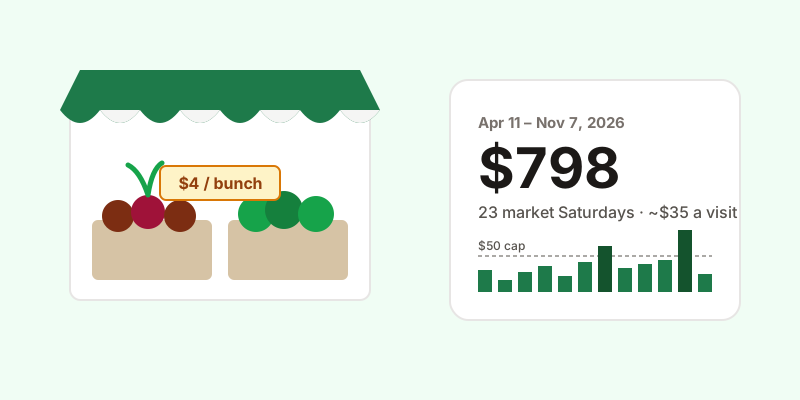
This year I tested it. From April 11 to November 7, I logged every farmers market purchase in GroceryTrack: 37 receipts over 23 Saturdays, $798 in total, about $35 a visit. The real number looked nothing like the one I'd been afraid of.
Where I started
Before the pandemic, I only walked through the market now and then and bought nothing.
What drew me in was taste. Supermarket broccoli often seemed picked before it was ripe, and it cooked up soft. Seasonal broccoli from the market surprised me the moment I picked it up: a small head felt heavier than a bigger one from the store. It was firm, with a real bite and a clean flavor. So I gave myself a small allowance: one or two things a week, as a treat.
Slowly I went more often and bought more. Two things helped. I found one or two vendors with fair prices, and I learned that many farmers give you the leafy tops of beets, carrots and daikon for free. By 2025 I was buying more and more of my vegetables there. But I still felt tense about it. I had no idea what I was really spending, so the old belief never quite went away.
How tracking changed the question
In 2026 I started using GroceryTrack. I scanned paper receipts, forwarded e-receipts and photographed what I bought. It takes a few minutes per trip. In return, every purchase landed in one place, sorted by store and category, week after week.
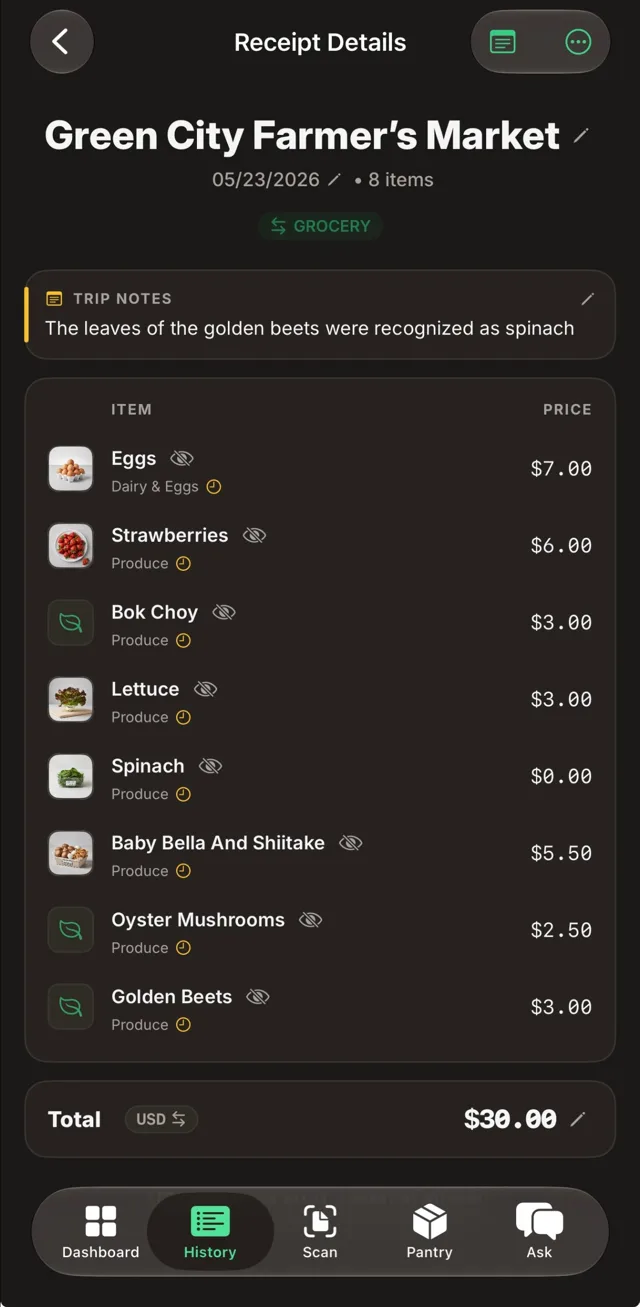
This mattered most at the farmers market. Many stands don't give receipts at all, and the ones that do are often handwritten. GroceryTrack had an answer: I take a photo of what I bought, and it identifies the items and estimates the prices. It isn't perfect (once it read my beet greens as spinach), but it turned a market with almost no receipts into data I could use.
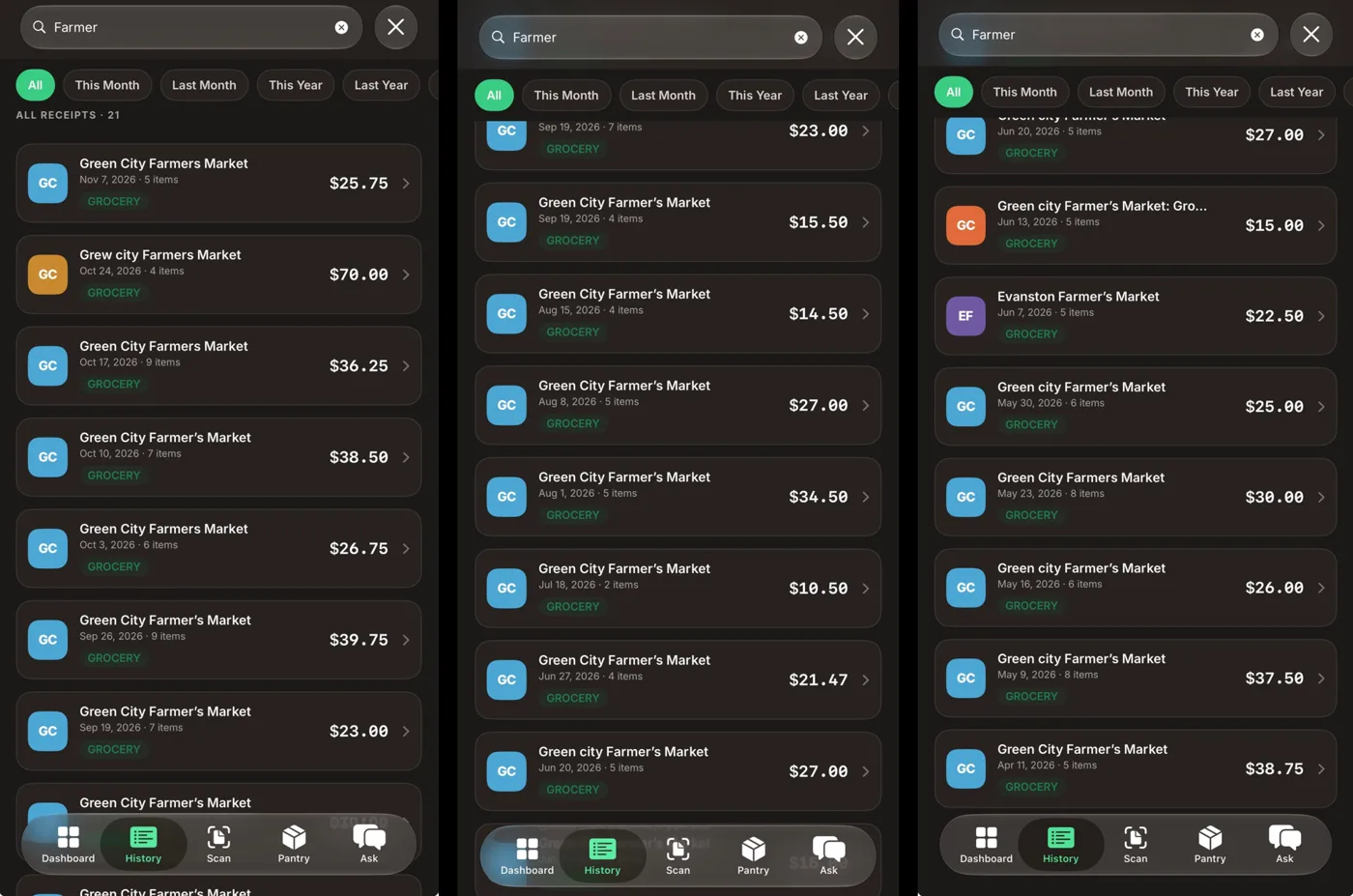
Searching “Farmer” in my History tab pulls up every market trip of the season, each with its date, item count and total.
Tapping a trip opens every item and price. My May 23 receipt also carries a trip note: the golden beet leaves came free, and the app read them as spinach at $0.00.
That changed the question. Instead of “Can I afford this?” I could ask “What am I actually spending?”
I paired the app with one simple rule: bring about $50 each Saturday and buy whatever I want within it. A special week, like a fall stock-up, can go over.
I stayed within my $50 weekly cap most Saturdays
21 of 23 market weeks under the cap · $799 for the season, Apr 11 – Nov 7, 2026
The receipts answered the question. 21 of 23 weeks stayed under the cap. The two weeks over were a big August market day ($68) and an October stock-up of garlic and apples that will last for months ($88).
What I learned
To see what really changed, I compared my whole produce basket, from every store and the market, before and during the season: the four weeks before my first market trip (March 14 to April 10) against the weeks I was in town from April to November. Comparing the market basket with the store basket from the same months wouldn't be fair. Once the market supplied my vegetables, the stores naturally supplied the rest.
Local, in-season produce rose from 25% to 59% of my whole basket
All produce from every store and the market, share of items
- Local crop, in season
- 25%59%
- Local crop, out of season
- 31%19%
- Never grown here (tropical)
- 39%16%
- Frozen, dried or canned
- 4%6%
About the same amount, different food. I bought about 13 produce items a week before the season and 14 during it. What changed is what they were.
Far more local and in season. Local crops in season went from 25% to 59% of my produce, and tropical imports fell from 39% to 16%. Part of this is the calendar, since very little grows in Illinois in March.
More vegetables and mushrooms. Mushrooms rose from 2% to 7% of my produce and other vegetables from 17% to 25%. Potatoes and squash fell from 17% to 9%. Fruit held steady at about 37%. Leafy greens didn't rise (19% before, 14% during).
I spend more on produce, and now I know where. My produce spending went from about $33 a week to about $56, and the market accounts for about $26 of that. My store produce spending barely changed even though I bought fewer items there, mostly because of bigger Costco packs and summer berries. Without weights, I can't tell whether I'm paying more per pound or just buying bigger packages.
My market basket was mostly vegetables; my store basket was mostly fruit
Share of produce items bought, Apr 11 – Nov 7, 2026
- Vegetables
- 38%14%
- Leafy & cruciferous greens
- 21%8%
- Mushrooms
- 12%3%
- Herbs, garlic & onions
- 11%7%
- Potatoes & squash
- 4%12%
- Fruit
- 14%56%
The market and the stores now do different jobs. During the season, the market supplied my vegetables, greens and mushrooms, and the stores supplied fruit. At the market, a produce item averaged $4.24, about 12% more than the $3.78 at stores. At Growing Home, an urban farm stand in Englewood, it was $2.78.
Some of it is free. I bought root vegetables with their greens attached 20 times at the market and twice at stores. Beet greens cook like spinach. Over time, my vendors even began saving the beet greens other customers didn't want and giving them to me.
Very little goes to waste. Of my market items from the last 12 weeks, 57 of 75 were eaten and only 4 spoiled.
How my habits changed
From a treat to a routine. I went from one or two items a week to buying most of my vegetables at the market, almost every Saturday I was in town from April to November.
From anxiety to a number. I no longer wonder whether I can afford it. I know what a market Saturday costs me, and I plan around it.
From a fixed list to the season. My shopping now follows the calendar: asparagus and morels in May, peaches in July, garlic and squash to store in October. Buying this way connected me to the seasons and to the land in a way I didn't expect.
From buying to using. Seeing what I bought, and what I threw away, made me more careful with food.
What comes next
I believe every change starts with awareness. My belief about the market didn't come from having no information. It came from having a little, and the wrong little. A season of receipts replaced an impression with facts.
My one regret is not starting sooner. My “before” is only four weeks of March receipts, when little grows here anyway. Had I tracked in 2024 or 2025, I could compare the same months year over year. From next season on, I'll have that.
Two things I'd like to measure next:
- Weight. A market receipt says “carrots, $4” but not how many pounds. With weights I could compare true unit prices across stores and see how much of each nutrient I actually eat.
- Organic. Most farms I buy from grow organically, but I didn't mark every item that way, and store receipts don't always say. Marking organic items consistently next season would show me what eating organic really costs.
What it could mean for you
Most of us carry beliefs about food and money we've never tested: “organic is out of reach,” “I waste too much,” “the market is for other people.” Some are true. Many aren't. You won't know until you look at your own receipts.
The farmers market is more expensive, and my receipts show it. But “expensive” was never the real question. The real question was whether I truly couldn't afford it, or whether there was a way to eat better without overspending. For me, there was. Here's what worked:
- Start with one thing. Buy one vegetable you're curious about and taste the difference.
- Find your value stand. Prices vary from stall to stall. My cheapest, Growing Home, averaged $2.78 an item.
- Ask for the tops. Beets, carrots, daikon and turnips often come with their greens. That's a free second vegetable.
- Bring a cap, not a list. About $50 keeps the week honest without spoiling the fun.
- Track it. A few weeks of receipts will tell you more than years of guessing.
Scan your next grocery receipt in GroceryTrack, and the one after that. In a few weeks you'll have your own numbers, and maybe a misconception of your own to retire.

Get started
Every new GroceryTrack account comes with a 30-day free trial of all Pro features: unlimited scans, full history, and advanced analytics. No credit card needed.
After the trial, basic features remain free. If you want the full experience, the Pro plan is available at $3.99/month for early adopters.

